
Category: Remote Jobs & Work From Home

  • How to Ask Your Boss to Work Remotely (With a Proposal Template That Gets a Yes)

    How to Ask Your Boss to Work Remotely (With a Proposal Template That Gets a Yes)

    Home / Journal / Remote Jobs & Work From Home

    Remote Jobs & Work From Home

    How to Ask Your Boss to Work Remotely (With a Proposal Template That Gets a Yes)

    How to ask your current employer for remote work: the business case, a ready-to-adapt proposal template, the conversation, answers to common objections and how to run a trial.

    • 10 min read
    • By 6FigureSwitch.com
    • Proposal template · Objections

    Many people who want to work remotely assume they need a new job to get it. Often, the fastest path is a conversation with the manager they already have. Your company knows your work, trusts your results and would rather keep you than replace you. What’s usually missing is a clear, low-risk proposal that makes saying yes easy.

    This guide shows you how to prepare that proposal: what to check before you ask, how to build a business case focused on the company’s needs, a ready-to-adapt proposal template, how to run the conversation, how to answer the most common objections and how to turn a trial period into a permanent arrangement.

    01Why how you ask matters as much as what you ask

    Managers rarely say no to remote work because they dislike the idea. They say no because they’re worried about specific risks: slower communication, reduced visibility, fairness with the rest of the team, or losing control of deadlines. A request that addresses those worries before they’re raised is much more likely to succeed.

    The key shift: don’t frame it as a personal favor. Frame it as a way to keep or improve your results, with a plan to protect everything your manager cares about.

    Don’t ask for remote work as a perk. Propose it as a better way to deliver the same results.

    02Before you ask: check these five things

    • Company policy. Read your handbook or intranet. Some companies already have a flexible work policy you can point to.
    • Precedent. Does anyone in your team or company already work remotely, even part-time? That makes your request easier.
    • Your track record. Your request is strongest after a period of solid results. If you’ve just missed deadlines, wait and rebuild first.
    • Your role. List which of your tasks can be done remotely and which truly need you on site. Be honest.
    • Your setup. Make sure you have a quiet workspace, reliable internet and the equipment you’d need.

    03Build your business case

    Your business case should answer one question for your manager: what’s in it for the team? Gather evidence for these points:

    Point 1

    Productivity

    Identify the work that benefits from fewer interruptions: writing, analysis, planning, deep focus tasks. If you’ve worked from home before (even occasionally), note what you delivered on those days.

    Point 2

    Time and energy

    Calculate your commute time per week. Explain how part of that time will go back into focused work or earlier availability.

    Point 3

    Retention

    Without making threats, you can mention that flexibility matters to you long term. Companies know that replacing an experienced employee is costly.

    Point 4

    Continuity

    Show how communication, meetings and deadlines will work: core hours, response times, tools and regular check-ins.

    Tip Start with a modest request, such as two remote days a week or a three-month trial. A small, reversible yes is easier to give than a big, permanent one.

    04Remote work proposal template

    Put your request in writing. A one-page proposal shows professionalism and gives your manager something to share with their own boss or HR. Adapt this structure:

    1. Request. “I’d like to propose working remotely [two days per week / full-time] starting [date], beginning with a [3-month] trial.”2. Why it benefits the team. “Remote days would allow me to focus on [deep work tasks], which I expect to [improve turnaround / quality]. I’d also reclaim [X hours] of commuting each week, part of which I’d use for [earlier availability / project work].”3. How I’ll stay available. “I’ll be online during core hours of [9:00–17:00], respond to messages within [1 hour], attend all meetings by video and keep my calendar up to date.”4. How we’ll measure success. “We can track [deadlines met, output, response times, stakeholder feedback]. I suggest a review at [6 weeks] and at the end of the trial.”5. Setup. “I have a dedicated workspace, reliable internet and [equipment]. I’ll follow all security and data policies.”6. Flexibility. “I’ll come to the office for [team meetings / key events] whenever needed, and we can adjust the arrangement at any time.”

    05How to have the conversation

    1. Book a dedicated meeting. Don’t ask in the hallway or at the end of another meeting. “Could we have 20 minutes this week to discuss a proposal about how I work?”
    2. Choose the timing. Avoid busy periods, right after a mistake or before a big deadline. Right after a successful project is ideal.
    3. Open with your commitment. “I enjoy my work here and want to keep delivering strong results. I have an idea that I think could help.”
    4. Present the proposal briefly, then share the written version.
    5. Ask for concerns. “What would worry you about this?” Listening first makes you look reasonable and gives you the objections to address.
    6. Propose next steps. “Would you be open to a three-month trial with a review at six weeks?”

    06How to handle common objections

    Objection

    "How will I know you're working?"

    Offer visibility: a short daily or weekly update, shared task boards and agreed response times. Focus the discussion on output, not hours.

    Objection

    "The rest of the team will want it too."

    Suggest it as a pilot that could inform a team policy. Propose clear criteria that anyone could meet, which keeps it fair.

    Objection

    "Collaboration will suffer."

    Commit to being in the office for key collaboration days and to joining all meetings by video. Offer to set up a weekly team check-in if one doesn’t exist.

    Objection

    "Our clients expect you on site."

    Separate client-facing days from focus days. Propose remote work only on days without client meetings.

    Objection

    "It's not company policy."

    Ask whether exceptions or trials are possible, and offer to help HR draft guidelines based on your trial.

    07Run a trial that turns into a permanent yes

    If you get a trial, treat it as an audition. The goal is to make the arrangement so smooth that ending it would feel like a step backward:

    • Over-communicate early. Share brief end-of-day updates in the first weeks, even if nobody asks.
    • Be fast and reachable during core hours. Response time is what managers notice most.
    • Deliver visible wins. Plan one or two pieces of focused work you can complete during the trial.
    • Track results. Keep a simple log of deliverables and deadlines met.
    • Ask for feedback at the midpoint review and adjust quickly.
    • Propose making it permanent at the final review, using your log as evidence.

    Set yourself up to succeed at home

    A trial can fail for simple practical reasons. Prepare these before your first remote day:

    • A dedicated workspace with a door if possible, good light and a comfortable chair.
    • Reliable internet plus a backup option, such as a phone hotspot, for important calls.
    • A good headset and camera, so you sound and look professional in meetings.
    • Clear start and end rituals, like a short walk, so work doesn’t spill into your whole evening.
    • Agreements with your household about quiet hours and interruptions during calls.

    The email to request the meeting

    Keep the first message short and positive. Save the details for the meeting:

    Subject: A proposal about how I workHi [Manager],

    I’d like to share a proposal about adjusting my working setup in a way I believe will help me focus and keep delivering strong results for the team. Could we find 20 minutes this week or next to discuss it? I’ll bring a one-page summary.

    Thanks,
    [Your name]

    It signals that you’ve thought it through, and it gives your manager time to prepare instead of being surprised.

    A weekly update template for remote days

    Visibility is the number one concern of managers with remote employees. A short weekly update removes it. Send it every Friday:

    • Done this week: three to five completed items, with results where possible.
    • In progress: what you’re working on and the expected completion date.
    • Next week: your top priorities.
    • Blockers: anything you need from your manager or the team.

    It takes ten minutes to write and quickly becomes the most useful document your manager receives. It also builds the evidence you’ll need to make the arrangement permanent.

    An example: from five office days to three remote ones

    Here’s an illustrative example. A marketing specialist spends 90 minutes commuting each way and does most of her writing and analysis in the open office, constantly interrupted.

    She waits until a successful campaign launch, then asks her manager for a 20-minute meeting. She brings a one-page proposal: two remote days a week for three months, on Tuesdays and Thursdays when there are no client meetings, with core hours, a one-hour response time and a Friday update.

    Her manager worries about team fairness. She suggests treating it as a pilot that could become a team policy, with criteria anyone could meet. The trial is approved.

    During the trial she sends her Friday updates, finishes two long reports ahead of schedule and joins every meeting on camera. At the final review, her manager not only makes the arrangement permanent but adds a third remote day. Nothing about the result was luck; it was preparation, visibility and delivery.

    Your remote work agreement checklist

    Before your first remote day, make sure you and your manager have agreed on these points, ideally in writing:

    • Which days or how many days you’ll work remotely
    • Core hours when you’ll be online and reachable
    • Expected response time for messages and calls
    • Which meetings or events require you in the office
    • How and when you’ll share progress updates
    • Equipment, security and data rules you’ll follow
    • Trial length and review dates

    08If the answer is no

    A no today isn’t always a no forever. Respond calmly and ask what would need to change: “I understand. What would make you comfortable revisiting this in three months?” Write down the answer, work on it and ask again later.

    If remote work is essential to you and the company won’t move, that’s useful information. Many companies hire remotely for similar roles. Use the time to strengthen your skills and start a structured search for a remote position, while keeping your current job.

    09Frequently asked questions

    Should I ask for full-time remote or hybrid?

    Start with what's most likely to be accepted, often two or three remote days a week or a trial. Once you've proven it works, expanding the arrangement is much easier.

    Is it better to ask by email or in person?

    Have the conversation in person or by video, then follow up with your written proposal. The conversation builds trust; the document makes it concrete.

    Can I negotiate remote work in a job offer?

    Yes. It's often easier to agree on remote work before you start than after. Ask during the offer stage and get it in writing.

    How long should a remote work trial be?

    Two to three months is usually enough to show results without feeling like a big commitment. Ask for a midpoint check-in so any concerns can be fixed early rather than at the end.

    Do I need to explain personal reasons like childcare or commuting?

    You can mention them briefly, but keep the focus on how the arrangement supports your work. Managers can approve business cases more easily than personal favors, especially if others might ask too.

    What if I'm new to the company?

    It's usually better to build trust first. Deliver strong results for a few months, then make your request with evidence of your reliability.

    What if my manager agrees but HR doesn't?

    Ask your manager to support a formal trial, offer to document results, and request a clear explanation of the policy so you know what would need to change.

    The bottom line

    Getting a yes to remote work is less about luck and more about preparation. Check your policy and track record, build a business case focused on your team’s needs, present a written proposal with clear availability and success measures, address objections calmly and start with a trial. Then make the trial so successful that it becomes the new normal.

    And if your current company can’t offer the flexibility you want, The 6-Figure Career Switch shows you how to land a high-paying remote role elsewhere.

    Share this articlePinterestLinkedInFacebookX

    Keep reading

    More from the Journal.

    One remote-career playbook. Every week.

    Free, practical, no spam. Unsubscribe anytime.

  • 15 Remote Jobs for Beginners With No Experience (That Can Grow Into Six Figures)

    15 Remote Jobs for Beginners With No Experience (That Can Grow Into Six Figures)

    Home / Journal / Remote Jobs & Work From Home

    Remote Jobs & Work From Home

    15 Remote Jobs for Beginners With No Experience (That Can Grow Into Six Figures)

    Fifteen genuine entry points into remote work, why beginners get hired for each, where they can lead and how to land your first one.

    • 10 min read
    • By 6FigureSwitch.com
    • 15 jobs · growth paths

    Most lists of “remote jobs with no experience” fall into two camps: tiny gigs that pay a few dollars an hour, or jobs that quietly require years of experience. Neither helps if you want a real career you can do from home.

    This guide is different. The 15 roles below are genuine entry points into remote work: companies regularly hire beginners for them, they teach transferable skills, and each one has a clear path toward much higher-paid roles over time. For every job you’ll see what you’d do, why beginners get hired, where it can lead and one step you can take this week. Then you’ll learn how to land your first role and how to grow from there.

    01The truth about "no experience"

    “No experience” rarely means no skills. It means no experience in that exact job title. Employers hiring for entry-level remote roles look for signals that you’ll be reliable without supervision:

    • Clear writing. Remote teams communicate mostly in writing. Your application message is your first test.
    • Comfort with tools. Email, video calls, shared documents and chat apps like Slack.
    • Self-management. Examples of finishing work on time without being chased.
    • Transferable experience. Retail, hospitality, teaching, admin, volunteering and even organizing events all count when you describe them well.

    You probably have more of these than you think. The job of your CV is to make them visible.

    02How to pick the right starting role

    Choose based on two questions: What do I already do well? and Where do I want to be in three years? A great first remote job uses your current strengths and moves you toward a higher-paid field. Someone who loves helping people might start in customer support and grow into customer success. Someone organized might start as a virtual assistant and grow into operations or project management.

    Rule Your first remote job is a launch pad, not a destination. Pick the one with the best path, not only the best starting pay.

    03Customer-facing roles

    01Customer Support Representative

    Answer customer questions by email, chat or phone, solve problems and log feedback for the product team.

    Why beginners get hired: companies hire many support reps and train them on the product; retail and hospitality experience translates directly.Growth path: senior support, support team lead, customer success manager, support operations.First step: practice writing short, friendly, clear replies to common customer questions and add a sample to your application.

    02Customer Success Associate

    Help existing customers get value from a product: onboarding calls, check-ins and answering how-to questions.

    Why beginners get hired: it rewards empathy and organization more than technical background.Growth path: customer success manager, account manager, renewals and expansion roles.First step: learn what churn, retention and onboarding mean, and use those words in your CV.

    03Sales Development Representative (SDR)

    Find and contact potential customers, qualify their needs and book meetings for senior salespeople.

    Why beginners get hired: companies hire for drive and communication, then train the sales process.Growth path: account executive, sales manager; pay often includes commission, so performance raises income quickly.First step: write three short outreach emails for a product you like, focused on the customer’s problem.

    04Operations & admin roles

    04Virtual Assistant

    Manage calendars, email, travel, documents and small projects for a busy professional or a small team.

    Why beginners get hired: it relies on organization and reliability; admin, reception and office experience transfers well.Growth path: executive assistant, operations coordinator, project coordinator, operations manager.First step: list the tools you can use (Google Workspace, Microsoft 365, calendars, spreadsheets) and offer a small paid trial.

    05Data Entry & Data Quality Specialist

    Enter, check and clean data in systems and spreadsheets, making sure records are accurate.

    Why beginners get hired: accuracy and focus matter more than background.Growth path: operations analyst, data analyst, reporting specialist. Learning spreadsheets and SQL accelerates this path.First step: learn pivot tables and lookups in a spreadsheet and mention them in your application.

    06Project Coordinator

    Support project managers: track tasks, schedule meetings, take notes and keep documents up to date.

    Why beginners get hired: teams value organized people who communicate clearly, and many coordinators come from admin or event roles.Growth path: project manager, program manager, operations manager.First step: learn a project tool like Trello, Asana or Jira and document a project you’ve organized in your life or work.

    07Recruiting Coordinator

    Schedule interviews, communicate with candidates and keep the hiring pipeline organized.

    Why beginners get hired: it’s coordination-heavy, people-focused and a common entry point into HR.Growth path: recruiter, talent acquisition specialist, HR business partner, people operations.First step: learn the basics of applicant tracking systems and highlight scheduling and communication experience.

    05Content & marketing roles

    08Social Media Assistant

    Schedule posts, reply to comments, track basic metrics and help create simple content for brands.

    Why beginners get hired: many small businesses need help and value people who already understand the platforms.Growth path: social media manager, content marketer, marketing manager.First step: run one social account (yours or a local business’s) consistently for a month and track the results.

    09Content Writer

    Write blog posts, emails, product descriptions or help articles for businesses.

    Why beginners get hired: a portfolio matters more than a degree, and you can build one quickly.Growth path: content strategist, copywriter, SEO specialist, content marketing manager.First step: write three sample articles in a field you know well and publish them online.

    10Email Marketing Assistant

    Build and schedule email campaigns, clean contact lists and report on open and click rates.

    Why beginners get hired: email tools are easy to learn, and small businesses often need help with them.Growth path: email marketing specialist, marketing automation specialist, lifecycle marketing manager.First step: learn one email platform’s free plan and create a three-email welcome sequence as a sample.

    11Transcriptionist & Captioner

    Turn audio and video into accurate text for podcasts, videos, interviews or meetings.

    Why beginners get hired: it rewards fast, accurate typing and attention to detail.Growth path: editor, proofreader, content producer; specialized fields like legal or medical transcription pay more with training.First step: test your typing speed and accuracy, and practice transcribing a short podcast episode.

    06Tech-adjacent roles

    12Technical Support Specialist

    Help users solve problems with software, accounts or devices, often by chat or remote session.

    Why beginners get hired: patience and logical troubleshooting matter more than deep technical knowledge at the start.Growth path: IT support, systems administrator, cybersecurity analyst, cloud support engineer.First step: study for an entry IT certification such as CompTIA A+ and mention it as in progress.

    13QA Tester (Software Testing)

    Test apps and websites to find bugs, write clear reports and confirm fixes.

    Why beginners get hired: careful, curious people are hired and trained; clear bug reports are the key skill.Growth path: QA analyst, test automation engineer, software developer.First step: practice by testing a free app and writing three detailed bug reports with steps to reproduce.

    14Online Tutor or Teaching Assistant

    Teach a subject or language online, prepare materials and give feedback to learners.

    Why beginners get hired: your knowledge of a subject or language is the main requirement for many platforms.Growth path: instructional designer, corporate trainer, learning and development specialist.First step: record a short sample lesson and create one worksheet to show your teaching style.

    15AI Data Annotator / AI Trainer

    Label data, rate AI responses and write examples that help train and evaluate AI systems.

    Why beginners get hired: many companies need people with good judgment and strong writing in specific subjects or languages.Growth path: AI quality specialist, data operations, content specialist roles in AI companies.First step: be careful to apply only through well-known companies or platforms, and never pay to join.

    07How to land your first remote job

    1. Pick one or two target roles from the list. Applying to everything makes your CV vague.
    2. Rewrite your CV for that role. Put the target title at the top and translate your past experience: “Handled 60+ customer questions a day in a busy store” is customer support experience.
    3. Create one small proof. A sample support reply, a writing sample, a spreadsheet, a bug report or a lesson recording. It sets you apart from most beginners.
    4. Apply on remote job boards and filter carefully. Check location requirements and avoid anything that asks you to pay.
    5. Send short, specific applications and follow up after five working days.
    6. Use your network. Tell people what role you’re looking for. Many first remote jobs come from someone who already knows you’re reliable.

    Beginners don’t get hired for experience. They get hired for proof that they’ll be easy to work with.

    08From entry-level to six figures

    Your first remote job won’t pay six figures, and that’s fine. What matters is the path. People who grow fastest do three things:

    • They master the role, then document results. “Resolved 40 tickets a day with a 95% satisfaction score” is the start of your next promotion.
    • They learn the skills of the next role while doing this one. A support rep who learns SQL can move into support operations or analytics.
    • They ask for the path. In your first months, ask your manager what it takes to reach the next level, and check in every quarter.

    Within two to three years, many of these paths lead to roles like customer success manager, project manager, account executive or data analyst. Some of those have national medians around or above $100K; see our guide to remote jobs that pay $100K+.

    Red flags in beginner remote job offers

    Beginner remote jobs attract scammers because they know newcomers are eager. Walk away if you see:

    • Requests to pay for training, equipment or a “starter kit”.
    • Interviews conducted only by text message or chat apps, with no video call.
    • An offer that arrives without any real interview.
    • Pay that looks far too high for simple tasks.
    • A check sent to you to buy equipment, with instructions to send money back.

    Real employers never ask you to pay to work. When in doubt, find the job on the company’s own careers page and verify the recruiter on LinkedIn.

    Set up for remote work success

    Once you land the job, a few habits help you stand out quickly:

    • Over-communicate early. Share short daily updates in your first weeks so your manager sees your progress.
    • Create a quiet workspace with reliable internet and a headset for calls.
    • Keep regular hours that overlap with your team, and set clear boundaries at the end of the day.
    • Ask for feedback after your first month, and act on it visibly.

    09Frequently asked questions

    What's the easiest remote job to get with no experience?

    Customer support, virtual assistance and data entry are common starting points because companies hire many people for them and train on the job. The best choice is the one that matches your strengths.

    Do I need a degree for these jobs?

    Most of these roles don't require a degree. Clear communication, reliability and a small proof of your skills matter more.

    How do I avoid remote job scams as a beginner?

    Never pay to get a job, insist on a real interview with a verifiable person, and check that the job is listed on the company's official website.

    How long until I can earn more?

    Many people move up within the first one to two years by mastering the role, learning the next role's skills and asking for a clear growth path.

    The bottom line

    You don’t need years of experience to start working remotely. Choose an entry role that uses what you already do well and leads somewhere better, create one small proof of your skills, and apply with a short, specific message. Then treat the first job as a launch pad: master it, document your results and learn the skills of the next step.

    When you’re ready to go from entry-level to a high-paying role, The 6-Figure Career Switch gives you the full plan.

    Share this articlePinterestLinkedInFacebookX

    Keep reading

    More from the Journal.

    One remote-career playbook. Every week.

    Free, practical, no spam. Unsubscribe anytime.
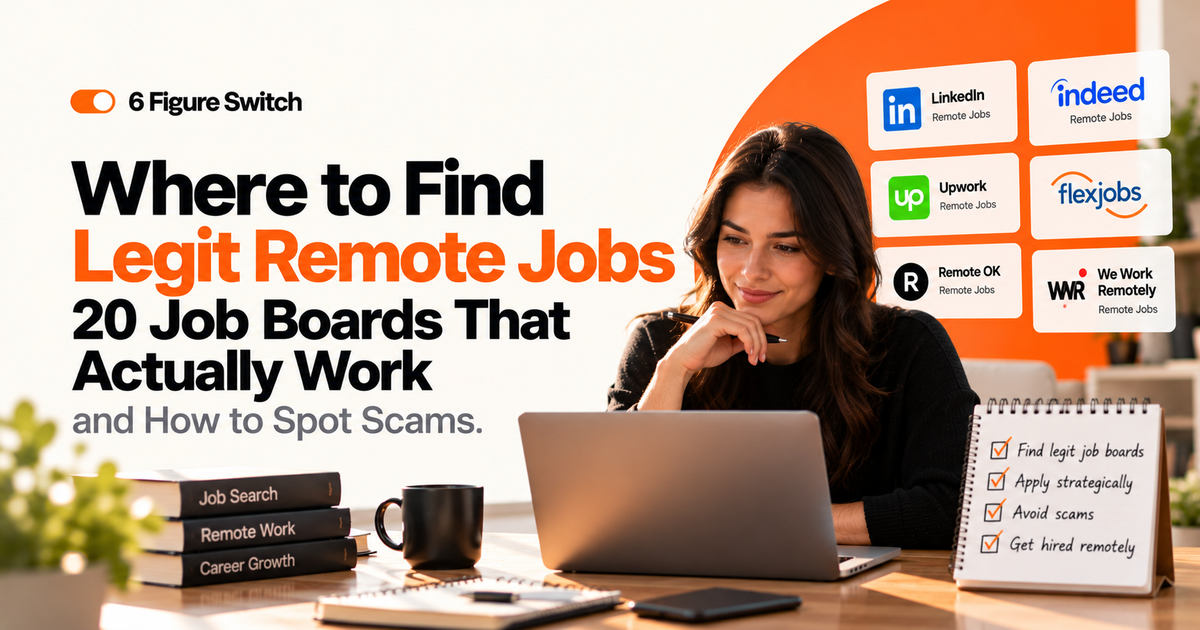
  • Where to Find Legit Remote Jobs: 20 Job Boards That Actually Work (and How to Spot Scams)

    Where to Find Legit Remote Jobs: 20 Job Boards That Actually Work (and How to Spot Scams)

    Home / Journal / Remote Jobs & Work From Home

    Remote Jobs & Work From Home

    Where to Find Legit Remote Jobs: 20 Job Boards That Actually Work (and How to Spot Scams)

    Twenty job boards and platforms where real remote jobs are posted, how to use each one, how to reach jobs that never get posted, and the red flags of a remote job scam.

    • 10 min read
    • By 6FigureSwitch.com
    • 20 job boards · scam checklist

    Type “remote jobs” into a search engine and you’ll get millions of results, endless listings that turn out to be hybrid, and a few offers that are too good to be true because they are. Finding real, well-paid remote work isn’t about searching harder. It’s about searching in the right places, in the right way.

    This guide lists 20 job boards and platforms that remote job seekers actually use, grouped by what they’re best for, with a tip for getting more out of each. Then you’ll learn how to reach the jobs that never get posted, how to recognize a scam in seconds, and a simple weekly system that keeps your search moving without taking over your life.

    01Why your remote job search feels broken

    Most people make the same three mistakes:

    • They search too broadly. “Remote” alone returns jobs you can’t apply to: hybrid roles, jobs limited to one country, or roles far outside your experience.
    • They rely on one site. Different companies post in different places. Startups, nonprofits and tech companies each have favorite boards.
    • They apply and wait. Remote roles attract many applicants. Without a referral or a follow-up, even strong candidates get lost.

    The fix is to combine a few big sites (filtered properly), a few remote-only boards, one or two niche boards for your field, and direct outreach. Let’s go through each.

    02The big job sites, used the right way

    These sites have the most listings. The trick is filtering hard so you only see real remote roles you qualify for.

    Best for: almost every field

    01LinkedIn Jobs

    Use the “Remote” filter, then set the location to the country or region you can legally work in. Turn on job alerts for your exact target title, and check the “People you can reach out to” section on each job to find a contact.

    Pro tip: roles posted in the last 24 to 72 hours get far fewer applicants. Sort by most recent.

    Best for: volume and non-tech roles

    02Indeed

    Search your title plus “remote” and use the remote filter. Indeed is especially strong for customer support, operations, healthcare administration and sales roles.

    Best for: researching companies

    03Glassdoor

    Use it to read reviews and salary reports before you apply, and to filter out companies with poor remote culture. Its job listings overlap with other sites, so treat it mainly as research.

    Best for: tech and startup roles in the US

    04Built In

    Strong for tech companies and their non-engineering roles: marketing, sales, operations, product. Filter by “Remote” and by company size.

    03Remote-only job boards

    These boards list only remote positions, so you skip the noise. Always check the location line: many remote jobs are still limited to certain countries or time zones.

    Best for: tech, design, marketing, support

    05We Work Remotely

    One of the longest-running remote job boards. Listings are paid by employers, which tends to filter out low-quality posts. Check it every few days.

    Best for: tech and startup roles

    06Remote OK

    Large remote board with salary ranges on many listings and filters by tag. Useful for spotting which skills are in demand right now.

    Best for: tech companies, all functions

    07Remotive

    A curated list of remote roles at tech companies, including non-technical jobs in marketing, sales, HR and customer success.

    Best for: browsing by category

    08Working Nomads

    Aggregates remote jobs by category and sends curated email alerts. Good for discovering companies you hadn’t heard of.

    Best for: company research + jobs

    09Himalayas

    Remote jobs with detailed company profiles, time-zone requirements and benefits. Helpful for checking where a company actually hires from.

    Best for: hand-screened listings (paid)

    10FlexJobs

    A subscription service that screens listings for legitimacy and includes part-time and flexible roles. Worth considering if you’re short on time and want fewer scams; free boards are fine otherwise.

    Best for: roles at online businesses

    11Dynamite Jobs

    Remote jobs at bootstrapped and online companies, often with salary ranges shown. Good for operations, marketing and assistant roles.

    Best for: established remote companies

    12Remote.co

    Lists remote jobs and profiles of remote-first companies, with Q&As about how they work. Useful for building a target list of companies.

    04Niche job boards by field

    Niche boards have fewer listings, but much less competition and better matches. Pick the ones for your target field.

    Best for: startups

    13Wellfound

    Formerly AngelList Talent. Startups post roles with salary and equity ranges, and you can apply directly to founders and hiring managers.

    Best for: nonprofits and impact work

    14Idealist

    Thousands of nonprofit and social-impact roles, many remote. Strong for program management, fundraising and communications.

    Best for: designers

    15Dribbble & Behance

    Design communities with job boards. Your portfolio on the same platform makes you easy to evaluate.

    Best for: writers and content roles

    16ProBlogger Jobs

    A long-running board for blogging, copywriting and content jobs, many of them remote or freelance.

    05Freelance platforms (a bridge into a new field)

    Freelancing is one of the fastest ways to get real experience in a new field while keeping your job. Start small, deliver well, and collect testimonials and portfolio pieces.

    Best for: broad freelance work

    17Upwork

    The largest general platform. Start with small, well-defined projects, write tailored proposals, and focus on 5-star reviews over price at the beginning.

    Best for: independent professionals

    18Contra

    Commission-free platform built around a portfolio-style profile. Good for designers, writers, marketers and developers.

    Best for: experienced specialists

    19Toptal

    A selective network for senior developers, designers, finance experts and project managers. Expect a demanding screening process.

    Best for: first clients

    20Your own network

    Former employers, colleagues and local businesses are often the easiest first clients. One message saying “I’m now offering X, do you know anyone who needs it?” can land your first project.

    06The hidden job market: jobs that never get posted

    Many roles are filled through referrals or direct outreach before they reach a job board. You can tap into that market with three habits:

    1. Build a target list of 20 to 30 remote companies in your field. Use the company profiles on Himalayas, Remote.co and LinkedIn to find them.
    2. Follow and engage. Follow the company and two or three people on the team you’d join. Comment thoughtfully on their posts for a few weeks.
    3. Reach out with value. Send a short message: who you are, why their company, one idea or observation, and a simple ask. “Would you be open to a 15-minute chat about how your team works?” goes further than “Are you hiring?”

    When a role opens, you’re no longer a stranger in a pile of applications. You’re the person who already showed interest and initiative.

    07How to spot a remote job scam

    Remote job scams are common, and they target people who are eager to work from home. Walk away immediately if you see any of these:

    • They ask you to pay for training, equipment, software or a “starter kit” before you start. Real employers don’t charge you to work.
    • They send you a check to buy equipment and ask you to send part of the money back or to a vendor. This is a classic fake-check scam.
    • The interview happens only by chat (Telegram, WhatsApp, text) with no video call and no real person you can verify.
    • The offer comes instantly, without a real interview, often for a vague role like “data entry” or “remote assistant” at an unusually high hourly rate.
    • They ask for sensitive information early, such as your bank details or ID number, before a written offer from a verifiable company.
    • The email domain doesn’t match the company website, or the recruiter uses a free email address for a large company.

    To verify a job, find it on the company’s own careers page, look up the recruiter on LinkedIn, and search the company name plus “scam”. If something feels off, trust that feeling. In the US you can report job scams to the Federal Trade Commission; in other countries, contact your national consumer protection authority.

    Rule If you have to pay to get the job, it isn’t a job.

    Make your application "remote-ready"

    Remote employers worry about one thing more than office employers do: will this person work well without someone looking over their shoulder? Answer that question before they ask it.

    • Show written communication. Remote teams run on writing. A clear, short, well-structured application message is already proof. Keep it to five or six sentences.
    • Mention remote experience, even partial. Working with colleagues in other offices, leading video meetings, managing projects in shared tools or working from home during busy periods all count.
    • Name the tools. Slack, Zoom, Google Workspace, Notion, Asana, Jira, Trello: list the ones you use. They’re easy signals that you’ll fit in quickly.
    • Give examples of self-management. “Delivered a 3-month project with weekly async updates to stakeholders in two time zones” says more than “self-motivated”.
    • Be clear about your time zone and availability. State your location and the hours you can overlap with the team. It removes a common reason to reject you.

    A good remote application message has a simple structure: one line on why this company, two lines on the most relevant result you’ve delivered, one line on how you work remotely, and a closing line inviting a conversation. Hiring managers read dozens of these. The short, specific ones get replies.

    Template “Hi [Name], I’m applying for [Role] because [specific reason about the company]. In my current role I [result with a number]. I’ve worked with distributed teams using [tools] and I’m available [hours / time zone]. I’d love to talk about how I could help [team goal].”

    08A weekly remote job search system (5 hours)

    DayTaskTime
    MondayCheck alerts on 2 big sites + 2 remote boards, save 10 matching roles45 min
    TuesdayTailor and send 3 applications (CV top section + short note)1 h
    WednesdayHidden market: 3 thoughtful comments + 2 outreach messages45 min
    ThursdayTailor and send 3 more applications1 h
    FridayFollow up on applications from last week, update your tracker30 min
    WeekendImprove one asset: portfolio piece, LinkedIn section or interview story1 h

    Track everything in a simple spreadsheet: company, role, link, date applied, contact, follow-up date and status. After a month, look at what’s working. If you get interviews from one board or from referrals, double down there and drop the rest.

    09Frequently asked questions

    Are paid job boards worth it?

    Sometimes. A paid service like FlexJobs screens listings, which saves time and reduces scams. But most legitimate remote jobs are also available on free boards. Start free and pay only if you need the filtering.

    How many remote jobs should I apply to each week?

    Quality beats quantity. Six to fifteen well-matched, tailored applications a week, plus outreach, usually works better than mass applying.

    Why do remote jobs say "US only" or list a time zone?

    Companies often limit remote roles because of employment law, taxes, payroll or the need to overlap working hours. Read the location requirements before applying to save time.

    Is freelancing a good way into a remote career?

    Yes, especially for career changers. Small freelance projects give you real experience, portfolio pieces and references in your new field, and some clients turn into full-time offers.

    The bottom line

    Legit remote jobs are out there, but they’re spread across many places. Filter the big sites properly, check a few remote-only boards, add the niche boards for your field, and spend part of every week on the hidden market. Stay alert for scams, track your search, and focus on the channels that bring you interviews.

    If you want a step-by-step plan that turns your search into offers, The 6-Figure Career Switch walks you through it.

    Share this articlePinterestLinkedInFacebookX

    Keep reading

    More from the Journal.

    One remote-career playbook. Every week.

    Free, practical, no spam. Unsubscribe anytime.

  • 25 Remote Jobs That Pay $100K+ (and How to Land One Without Starting Over)

    25 Remote Jobs That Pay $100K+ (and How to Land One Without Starting Over)

    Home / Journal / Remote Jobs & Work From Home

    Remote Jobs & Work From Home

    25 Remote Jobs That Pay $100K+ (and How to Land One Without Starting Over)

    The remote roles where six figures is realistic, with official median pay, the backgrounds that switch in fastest, and a first step for each.

    • 13 min read
    • By 6FigureSwitch.com
    • 25 jobs · BLS salary data

    Most people who want to work from home start by searching “remote jobs” and get buried in listings for data entry, surveys and call centers. Those jobs exist, but they rarely pay enough to change your life. The good news is that a different group of remote jobs pays six figures, and many of them are open to career changers who don’t have the “perfect” background.

    In this guide you’ll find 25 remote-friendly jobs where $100K+ is realistic, the official median pay for each one, the backgrounds that switch into them most easily, and a concrete first step you can take this week. At the end, you’ll get a simple five-step plan to land one without quitting your current job first.

    01Why most remote job lists miss the point

    Search engines and job boards are full of lists that mix six-figure careers with $12-an-hour gigs. They count how many remote jobs exist, not which ones can replace a good salary. If your goal is a real career switch, you need two things at the same time: work that can be done from anywhere, and a pay level that’s worth leaving your current job for.

    That’s why this list is short and specific. Every job here has a national median close to or above $100,000 and a track record of remote hiring.

    02How we picked these 25 jobs

    Every salary below is the median annual pay reported by the U.S. Bureau of Labor Statistics (May 2025 data). Median means half of workers in that occupation earn more and half earn less. Remote roles at well-funded companies often pay at or above the median, and senior people earn far more.

    We kept jobs that meet three criteria:

    • Remote-friendly: the core work can be done from a laptop, and companies regularly hire for it remotely.
    • Six figures is realistic: the median is at or near $100K, so you’re not chasing a rare top-1% salary.
    • Open to career changers: there’s a clear path in through skills, certifications or a portfolio, not only a specific degree.

    03All 25 jobs at a glance

    JobBLS median payCategory
    1. Software Developer$134,040Tech & security
    2. Information Security Analyst$129,180Tech & security
    3. Computer Network Architect$134,050Tech & security
    4. Database Administrator / Architect$126,760Tech & security
    5. Computer Systems Analyst$105,850Tech & security
    6. Computer Programmer$100,390Tech & security
    7. UX / Web Designer$99,520Tech & security
    8. Data Scientist$120,230Data & numbers
    9. Actuary$130,000Data & numbers
    10. Statistician$105,720Data & numbers
    11. Financial Analyst$103,570Data & numbers
    12. IT Manager (Computer & Information Systems)$175,140Leadership roles
    13. Financial Manager$166,570Leadership roles
    14. Marketing Manager$165,780Leadership roles
    15. Human Resources Manager$149,280Leadership roles
    16. Compensation & Benefits Manager$149,230Leadership roles
    17. Sales Manager$148,270Leadership roles
    18. Public Relations & Fundraising Manager$136,470Leadership roles
    19. Training & Development Manager$133,000Leadership roles
    20. Medical & Health Services Manager$123,860Business & operations
    21. Personal Financial Advisor$105,070Business & operations
    22. Project Management Specialist$102,320Business & operations
    23. Management Analyst / Consultant$101,860Business & operations
    24. Technical Writer$90,390Business & operations

    Tip Don’t pick by salary alone. The best job on this list is the one that reuses the most of what you already know.

    04Tech & security

    These roles have the most remote openings and the clearest skill paths. You don’t need a computer science degree for most of them, but you do need proof you can do the work.

    BLS median pay · $134,040

    01Software Developer

    You design, build and maintain the apps and systems companies run on. Most teams are distributed, so remote work is the norm rather than a perk.

    Switch in from: Analysts, QA testers, technical support, anyone who already automates parts of their job with spreadsheets or scripts.

    First step: Pick one language (Python or JavaScript), build three small projects that solve real problems, and publish them on GitHub.

    BLS median pay · $129,180

    02Information Security Analyst

    You protect a company’s systems and data: monitoring threats, fixing weaknesses and responding to incidents. Demand keeps growing as more work moves online.

    Switch in from: IT support, network or systems administration, compliance, audit, military or police backgrounds.

    First step: Study for the CompTIA Security+ certification. It’s the most common entry ticket into security roles.

    BLS median pay · $134,050

    03Computer Network Architect

    You design the networks and cloud infrastructure that connect offices, data centers and remote teams. Much of the work happens in cloud consoles, which makes it remote-friendly.

    Switch in from: Network technicians, systems administrators, telecom engineers.

    First step: Get hands-on with one cloud platform (AWS, Azure or Google Cloud) and earn its associate-level networking or architect certification.

    BLS median pay · $126,760

    04Database Administrator / Architect

    You organize, secure and speed up the databases a company depends on. When the data is slow or lost, the business stops, which is why the role pays well.

    Switch in from: Data analysts, BI developers, back-office roles that live in large spreadsheets.

    First step: Learn SQL properly, then practice designing and optimizing a database for a real dataset.

    BLS median pay · $105,850

    05Computer Systems Analyst

    You sit between the business and the tech team, figuring out which systems a department needs and how to make them work together.

    Switch in from: Operations, finance, logistics or healthcare professionals who know a business process inside out.

    First step: Document one process at your current job, propose a better tool or workflow, and turn it into a case study.

    BLS median pay · $100,390

    06Computer Programmer

    You write and test the code that turns a design into working software, often maintaining existing systems in finance, insurance or government.

    Switch in from: Self-taught coders, IT support, engineers from other fields.

    First step: Choose the language your target industry uses most and contribute to one open-source project to show real-world code.

    BLS median pay · $99,520

    07UX / Web Designer

    You design websites and app screens that are easy to use. Senior designers at product companies usually earn well above the median.

    Switch in from: Graphic designers, marketers, customer service and teachers (who already think about how people learn and use things).

    First step: Redesign one clunky app or website you know, explain your choices, and build a three-project portfolio.

    05Data & numbers

    If you like patterns and numbers, these roles turn that into one of the most remote-friendly career paths.

    BLS median pay · $120,230

    08Data Scientist

    You use statistics and code to answer business questions: who will churn, which price works best, where costs can be cut.

    Switch in from: Analysts, researchers, engineers, economists, anyone with a quantitative degree.

    First step: Learn Python with pandas, then publish two projects that start with a business question and end with a recommendation.

    BLS median pay · $130,000

    09Actuary

    You measure financial risk for insurers and pension funds. It’s exam-heavy, but once qualified the work is stable, well paid and often remote.

    Switch in from: Math, finance and economics graduates, accountants who enjoy the numbers more than the bookkeeping.

    First step: Pass the first professional exam (Probability) while still employed. Many employers pay for the rest.

    BLS median pay · $105,720

    10Statistician

    You design studies and analyze data for health, tech, government and research. Clean analysis can be done from anywhere.

    Switch in from: Researchers, lab scientists, social science graduates, survey and market research roles.

    First step: Refresh your statistics and learn R or Python, then analyze a public dataset end to end.

    BLS median pay · $103,570

    11Financial Analyst

    You build models and forecasts that help companies decide where to invest. Corporate finance teams increasingly work hybrid or remote.

    Switch in from: Accountants, bankers, business owners, sales operations.

    First step: Get very good at Excel modeling and build a three-statement model for a public company you admire.

    06Leadership roles

    Managers earn the highest medians on this list. They’re harder to land from scratch, but if you already lead people or projects, your next step could be a remote one.

    BLS median pay · $175,140

    12IT Manager (Computer & Information Systems)

    You run a company’s technology: teams, budgets, vendors and security. Many tech-first companies hire these roles remotely.

    Switch in from: Senior IT staff, project managers in tech, systems administrators with team-lead experience.

    First step: Lead one visible project at work (a migration, a new tool rollout) and measure the result.

    BLS median pay · $166,570

    13Financial Manager

    You oversee reporting, budgets and cash for a company or a division. Finance leadership at online businesses is often fully remote.

    Switch in from: Senior accountants, controllers, financial analysts.

    First step: Take ownership of a reporting process and present it to leadership. That’s the bridge from analyst to manager.

    BLS median pay · $165,780

    14Marketing Manager

    You plan campaigns, manage budgets and lead the team that brings in customers. Digital marketing is one of the most remote-ready functions.

    Switch in from: Sales, content creators, social media managers, small business owners.

    First step: Run one campaign end to end (even for a friend’s business) and report the numbers: cost, leads, sales.

    BLS median pay · $149,280

    15Human Resources Manager

    You lead hiring, people policies and employee experience. Distributed companies need HR leaders who understand remote teams.

    Switch in from: HR specialists, recruiters, office managers, team leads.

    First step: Earn an HR certification like SHRM-CP and specialize in remote hiring or onboarding.

    BLS median pay · $149,230

    16Compensation & Benefits Manager

    You design pay structures and benefits so a company can attract and keep people fairly. It’s analytical, specialized and well paid.

    Switch in from: Payroll, HR specialists, financial analysts.

    First step: Learn salary benchmarking and pay-equity analysis, then build a sample pay structure for a fictional company.

    BLS median pay · $148,270

    17Sales Manager

    You lead a sales team, set targets and coach reps. Remote software and service companies hire sales leaders across time zones.

    Switch in from: Top-performing sales reps, account managers, business owners.

    First step: Document your sales results in numbers (quota, deals, growth) before you apply. Sales hiring is numbers-first.

    BLS median pay · $136,470

    18Public Relations & Fundraising Manager

    You shape how an organization is seen and you raise money for nonprofits. Media relations and donor outreach work well remotely.

    Switch in from: Journalists, communications staff, event planners, nonprofit coordinators.

    First step: Build a portfolio: three press pitches, one crisis statement and one fundraising appeal.

    BLS median pay · $133,000

    19Training & Development Manager

    You build the programs that help employees learn new skills. Online training has made this role easy to do remotely.

    Switch in from: Teachers, coaches, trainers, instructional designers.

    First step: Turn one lesson you’ve taught into an online course module. It shows you can design learning, not only deliver it.

    07Business & operations

    These roles reward people who understand how organizations work. They’re some of the easiest to move into from a traditional job.

    BLS median pay · $123,860

    20Medical & Health Services Manager

    You manage operations, staff and budgets in healthcare organizations. Telehealth and health-tech companies hire many of these roles remotely.

    Switch in from: Nurses, clinic coordinators, medical billing and administrative staff.

    First step: Learn the basics of healthcare operations and data (scheduling, billing, compliance) and highlight your clinical experience.

    BLS median pay · $105,070

    21Personal Financial Advisor

    You help people plan their savings, investments and retirement. Video calls made remote advising normal.

    Switch in from: Bankers, accountants, insurance agents, anyone who already gets asked for money advice.

    First step: Check which licenses apply where you live, and start with the certification path your target firm prefers.

    BLS median pay · $102,320

    22Project Management Specialist

    You keep projects on time and on budget. Every industry needs project managers, and remote teams need them more.

    Switch in from: Coordinators, team leads, engineers, event planners, teachers. If you’ve ever run a project, you qualify more than you think.

    First step: Rewrite your CV around projects you delivered, then study for the CAPM (entry) or PMP (with experience).

    BLS median pay · $101,860

    23Management Analyst / Consultant

    You study how a company works and recommend ways to cut costs or grow. Many consultants work remotely or freelance.

    Switch in from: Experienced professionals in any industry, MBAs, operations and strategy roles.

    First step: Pick the industry you know best and package your expertise as a clear problem you solve.

    BLS median pay · $90,390

    24Technical Writer

    You turn complex products into clear guides and documentation. The median is just under $100K, but it’s one of the easiest remote roles to break into, and pay rises with seniority in software and AI companies.

    Switch in from: Teachers, journalists, support agents, engineers who write well.

    First step: Write documentation for a real open-source tool and use it as your first writing sample.

    08How to land one without starting over

    A list of jobs is only useful if you can actually get one. This is the same approach we teach in The 6-Figure Career Switch, in short:

    1. Pick one lane, not five. Choose the job above that best matches what you already do well. A teacher becomes a training manager or instructional designer faster than a data scientist. Overlap with your past is your shortcut.
    2. Close only the gaps that matter. Read ten job posts for your target role and list the skills that show up in at least half of them. Learn those, ignore the rest. One certification or one strong project usually beats three courses.
    3. Translate your experience. Rewrite your CV and LinkedIn in the language of the new role. “Managed the school timetable” becomes “Coordinated schedules and resources for 40 staff and 600 students.” Same job, new vocabulary.
    4. Build proof. Hiring managers trust evidence over potential. A portfolio, a case study or a small freelance project shows you can do the work, and it gives you something real to talk about in interviews.
    5. Apply with a system, then switch safely. Target 10 to 15 well-matched roles a week, follow up, and track everything. Keep your current income until the new offer is signed. That’s the whole idea of the switch: no leap into the void.

    You don’t need to start over. You need to translate what you already know into the language of a better-paid role.

    09Mistakes that slow career changers down

    • Applying everywhere. Sending 200 generic applications feels productive but rarely works. Fewer, tailored applications get more interviews.
    • Collecting courses instead of proof. Certificates help, but a project you can show and explain is what gets you hired.
    • Hiding your past. Your previous career is an asset. A nurse moving into health operations or a salesperson moving into sales management has an edge, so lead with it.
    • Ignoring time zones. Many “remote” jobs are remote within one country or time zone. Read the location line before you apply.
    • Quitting too early. The switch takes months, not weeks. Protect your income while you build skills and apply.

    10Frequently asked questions

    Can I get a $100K remote job without a degree?

    Yes, especially in software development, cybersecurity, UX design, sales and technical writing, where portfolios and certifications often matter more than degrees. Leadership and finance roles are harder without a degree, but experience can make up for it.

    Which remote job is the fastest to switch into?

    It depends on your background. Project management, technical writing and customer-facing sales roles are often the quickest because they reuse skills you already have. Pick the role that overlaps most with your current job.

    Do remote jobs pay less than office jobs?

    Some companies adjust pay by location, others pay the same everywhere. Check the salary range in the job post, and use the medians in this guide as a reference when you negotiate.

    Can I apply to US remote jobs from another country?

    Some companies hire internationally as contractors or through employer-of-record services, but many US roles are limited to US residents. Filter job boards by "worldwide" or by your region, and read the eligibility section before applying.

    The bottom line

    Six-figure remote work isn’t reserved for a lucky few. It’s a set of specific roles, each with a clear way in. Pick the one closest to what you already do, close the few skill gaps that matter, show proof, and apply with a plan while your current job pays the bills.

    If you want the full step-by-step version, with templates for your CV, LinkedIn and job search, that’s exactly what The 6-Figure Career Switch walks you through.

    Source: U.S. Bureau of Labor Statistics, Occupational Outlook Handbook, median pay (May 2025 data): computer & IT, math, management, business & financial, media & communication. Pay varies by employer, location and experience.

    Share this articlePinterestLinkedInFacebookX

    Keep reading

    More from the Journal.

    One remote-career playbook. Every week.

    Free, practical, no spam. Unsubscribe anytime.