
Author: yanecompany

  • Feeling Stuck in Your Career? 9 Practical Steps to Get Unstuck This Month

    Feeling Stuck in Your Career? 9 Practical Steps to Get Unstuck This Month

    Home / Journal / Self-Improvement & Mindset

    Self-Improvement & Mindset

    Feeling Stuck in Your Career? 9 Practical Steps to Get Unstuck This Month

    Nine practical steps and a 30-day plan to figure out why you feel stuck at work, find direction and start moving again, whether you stay or switch careers.

    • 10 min read
    • By 6FigureSwitch.com
    • 9 steps · 30-day plan

    Feeling stuck in your career is one of the most common and least talked-about frustrations at work. You’re not in crisis. The job pays the bills. But every week feels like the last one, the future looks like more of the same, and the energy you used to have for your work is slowly fading.

    The good news is that being stuck is rarely a permanent state. It’s usually a mix of unclear direction, lack of progress and too much thinking without action. This guide helps you figure out which kind of stuck you are, then gives you nine practical steps and a 30-day plan to start moving again, whether that means growing where you are or preparing a bigger change.

    01Why you feel stuck

    The feeling usually comes from a gap between where you are and where you want to be, combined with the sense that nothing you do will close it. Common causes include:

    • No visible progress. Same tasks, same title, same salary for too long.
    • No clear direction. You know you want “something else” but can’t name it.
    • Values mismatch. Your work no longer reflects what matters to you.
    • Skills plateau. You’ve stopped learning, and your role doesn’t push you.
    • External constraints. Money, family or location limit your options, or seem to.

    Notice that most of these are about movement, not about the job itself. That’s why the solution starts with small, concrete progress.

    02Which kind of stuck are you?

    Type 1

    Stuck but clear

    You know what you want (a promotion, a new field, remote work) but you’re not moving toward it. Your main problem is action and planning. Focus on steps 5 to 9.

    Type 2

    Stuck and unclear

    You feel the need for change but don’t know what kind. Your main problem is direction. Focus on steps 1 to 4 before anything else.

    Type 3

    Stuck and drained

    You’re too tired to think about change at all. Your main problem is energy. Start with step 3 and protect your recovery first, then move on.

    03The 9 steps to get unstuck

    Step 1 · 30 minutes

    Name what's actually wrong

    “I’m stuck” is too vague to act on. Specific problems have specific solutions.

    Do this: write one page answering: What exactly frustrates me? Since when? What would “better” look like in six months? Be concrete: income, tasks, people, schedule, growth.

    Step 2 · 20 minutes

    Separate the job from the career

    Sometimes the problem is your manager, team or company, not your profession. Changing jobs is much easier than changing careers.

    Do this: list what you’d keep if you could design your role, and what you’d change. If most of the “change” items are about the environment, look at other companies first.

    Step 3 · 2 weeks

    Recover your energy

    It’s hard to make good decisions when you’re exhausted. Small recovery habits create the energy you need for change.

    Do this: for two weeks, protect your sleep, take a daily walk and add one thing to your week that’s just for you. Notice how your outlook shifts.

    Step 4 · 2–4 weeks

    Run small experiments

    When you don’t know what you want, thinking more won’t fix it. Trying small things will.

    Do this: pick two ideas and test each in a low-risk way: a short course, a conversation with someone in the field, a weekend project or volunteering.

    Step 5 · 15 minutes

    Set one 90-day goal

    Vague goals keep you stuck. One clear, measurable goal gives every week a direction.

    Do this: write one goal with a deadline, for example “Have three interviews for project manager roles by March 31” or “Complete a data analysis certificate and one portfolio project in 90 days”.

    Step 6 · ongoing

    Learn one thing that moves you forward

    Learning is one of the fastest ways to feel unstuck because progress becomes visible every week.

    Do this: choose one skill directly linked to your goal and commit to 4 to 5 hours a week. Finish one course and one small project before starting anything else.

    Step 7 · 1 hour/month

    Make your work visible

    Many people are stuck because the right people don’t know what they can do.

    Do this: share one result per month with your manager, update your LinkedIn, and post about what you’re learning. Visibility creates opportunities you can’t predict.

    Step 8 · 5 × 30 minutes

    Talk to five people this month

    Most opportunities come through people, and conversations quickly reveal options you hadn’t considered.

    Do this: reach out to five people: a mentor, a former colleague, someone in a role you’re curious about, a recruiter in your field and someone who made a career change.

    Step 9 · 1 day

    Make one bold move

    At some point, small steps need one bigger step to break the pattern.

    Do this: ask for the promotion conversation, apply to three roles that feel slightly out of reach, propose a new project or commit to your career change plan with a start date.

    04Your 30-day get-unstuck plan

    WeekFocusActions
    Week 1ClarityName what's wrong (step 1), separate job vs career (step 2), start recovery habits (step 3)
    Week 2ExplorationStart two small experiments (step 4), have your first two conversations (step 8)
    Week 3DirectionSet your 90-day goal (step 5), choose and start one skill (step 6)
    Week 4MomentumMake your work visible (step 7), finish your five conversations, make one bold move (step 9)

    At the end of the month, review what changed. You may not have a new job yet, but you’ll have direction, momentum and new options, which is the opposite of stuck.

    Clarity comes from action, not thought. Move first, and the direction gets clearer as you go.

    Get unstuck without leaving your job

    Sometimes the best next step is inside your current company. Before you start applying elsewhere, try these five moves:

    • Ask for a stretch project. Volunteer for a project slightly beyond your current role: a new process, a tool rollout, a client you haven’t worked with.
    • Have a career conversation with your manager. Say what you want to grow toward and ask what it would take. Many managers can’t help until you tell them.
    • Explore internal moves. Other teams may need exactly the skills you have, plus your knowledge of the company.
    • Redesign part of your role. Automate or delegate the tasks that drain you and propose taking on work that energizes you.
    • Use the learning budget. Many companies pay for courses or certifications. Ask what’s available and connect it to your 90-day goal.

    If these doors stay closed after a few honest attempts, that’s useful information too. It tells you the next step is outside, and you’ll leave with new skills and results to show.

    An example: stuck, then moving

    Here’s an illustrative example. An accountant in his late thirties has had the same title for six years. He’s competent, well paid enough and completely bored. He tells himself he’s “just tired”, but the feeling has lasted two years.

    In week 1, he names the problem: repetitive work, no learning and no path to a bigger role. He realizes he likes his company but not his tasks. In week 2, he tests two ideas: a short course in financial modeling and a conversation with a colleague in the planning team. The modeling work energizes him.

    In week 3, he sets a 90-day goal: build two forecasting models and move into a financial planning role. In week 4, he tells his manager, shares a first model he built for his own team, and asks to help on the next budget cycle.

    Three months later he’s working part of his week with the planning team, learning fast, and has a clear case for a new role. Nothing dramatic happened. He simply replaced thinking with small, visible steps.

    05Use the people around you

    Getting unstuck alone is hard. A few relationships make it much easier:

    • A mentor who is a few steps ahead on the path you’re considering.
    • An accountability partner, a friend or colleague with whom you share weekly goals.
    • Your manager, if the relationship is good. Many managers will help you grow if you tell them what you want.
    • Online communities of people in your target field or making similar changes.
    • Supportive family or friends who understand why this matters to you.

    Be selective. Share your plans with people who encourage growth, and keep early ideas away from people who tend to talk you out of change.

    06Thinking traps that keep you stuck

    "It's too late for me."

    People change careers in their 30s, 40s and 50s all the time, usually by building on what they already know. Age shapes your strategy, not your options.

    "I need to figure everything out first."

    You only need to know the next step. Plans become clearer as you move.

    "I've invested too much to change now."

    Your past experience isn’t lost. It’s what you’ll carry into the next role. The real cost is spending more years in a situation that doesn’t fit.

    "Other people have it easier."

    Comparison drains energy you need for your own progress. Measure yourself against where you were last month.

    A simple weekly check-in

    Stuckness creeps back when weeks pass without reflection. Every Sunday, spend ten minutes answering these four questions in a notebook:

    1. What moved forward this week? Even small wins count: a lesson finished, a message sent, a conversation had.
    2. What drained me, and can I reduce it? Notice patterns in your energy.
    3. What’s the one most important thing for next week? Choose only one.
    4. Who could help me with it? Name a person, then send the message on Monday.

    After a month, read back through your answers. Seeing your progress in writing is one of the most effective cures for the feeling of being stuck, because it shows you that you’re not.

    07When to get extra support

    Career frustration is normal, but sometimes it’s part of something bigger. If you’ve felt persistently low, anxious or exhausted for weeks, are struggling to sleep or function, or feel hopeless about the future, talk to someone you trust and consider reaching out to a doctor or a mental health professional. Looking after your wellbeing is part of building a better career, not separate from it.

    A career coach can also help if you’ve worked through these steps and still feel unclear, especially when the decision has big financial or family implications.

    08Frequently asked questions

    How do I know if I should quit my job?

    Look for a pattern over months, not a bad week. If you've tried to improve your situation (talking to your manager, changing projects, learning new skills) and nothing changes, it's time to plan a move, ideally while still employed.

    Is it normal to feel stuck after many years in the same job?

    Very common. Skills plateau and routines settle in. The steps in this guide are designed exactly for that situation.

    What if I can't afford to change careers?

    Start with changes that don't cost money: conversations, free courses, small projects and making your work visible. Build savings in parallel so a future move feels safe.

    How long does it take to feel unstuck?

    Many people feel a shift within a few weeks of taking action, because progress itself restores energy. Bigger changes, like a new role, typically take a few months.

    The bottom line

    Feeling stuck doesn’t mean you’re failing. It means you’ve outgrown something and haven’t started the next chapter yet. Name what’s wrong, recover your energy, test small ideas, set one 90-day goal and talk to people. Within a month, you can replace the stuck feeling with momentum.

    If your next chapter is a better-paid, flexible role, The 6-Figure Career Switch gives you the step-by-step plan.

    Share this articlePinterestLinkedInFacebookX

    Keep reading

    More from the Journal.

    One remote-career playbook. Every week.

    Free, practical, no spam. Unsubscribe anytime.

  • How to Negotiate Your Salary: Word-for-Word Scripts for Every Situation

    How to Negotiate Your Salary: Word-for-Word Scripts for Every Situation

    Home / Journal / Resume, LinkedIn & Interviews

    Resume, LinkedIn & Interviews

    How to Negotiate Your Salary: Word-for-Word Scripts for Every Situation

    A simple preparation process and ten word-for-word scripts to negotiate a higher salary, from the first recruiter call to the final offer, plus an email template.

    • 10 min read
    • By 6FigureSwitch.com
    • 10 scripts · email template

    Most people accept the first salary offer they receive. They’re relieved to get the job, worried about seeming greedy, and unsure what to say. Yet in many cases, employers expect some negotiation and leave room for it. A short, polite conversation can raise your pay for years, because every future raise usually builds on your starting salary.

    This guide gives you a simple preparation process and ten word-for-word scripts for the moments that matter: when a recruiter asks your expectations, when the offer arrives, when they say no, when you’re changing careers and when you’re asking for a raise. Adapt the words to your own voice, but keep the structure.

    01Why most people don't negotiate (and why you should)

    The reasons are almost always emotional, not logical:

    • Fear of losing the offer. A respectful, well-prepared request very rarely makes a company withdraw an offer.
    • Not knowing the market rate. Without a number, asking feels like guessing. Research fixes that.
    • Feeling lucky to be chosen, especially after a long search or a career change.
    • Not having the words. That’s what the scripts below are for.

    Remember the math: a difference of a few thousand per year compounds through every future raise, bonus and job change. Ten minutes of discomfort can be worth a lot over a career.

    You don’t get paid what you’re worth. You get paid what you negotiate, so prepare like it matters.

    02Prepare in 3 steps

    Step 1

    Research the market range

    Check salary data for the exact role, level and location (or the company’s pay policy for remote roles). Use salary sites, the ranges in job posts, official labor statistics and conversations with people in the role. Write down a low, middle and high figure.

    Step 2

    Define your three numbers

    Walk-away: the minimum you’d accept, based on your expenses and alternatives. Target: what you’re aiming for, usually around the upper middle of the range. Anchor: what you’ll ask for, slightly above your target, still justifiable.

    Step 3

    List your value

    Write three reasons you deserve the higher end: results you’ve delivered, skills that are rare in the role, experience that reduces risk for them. You’ll use these as your justification, not your personal needs.

    Remember Base your request on the role’s market value and your results, never on what you need to pay rent. Employers pay for value, not for need.

    03How to find your number

    Use several sources and look for where they overlap:

    • Job posts with salary ranges. Many regions now require ranges in job ads, and many remote companies publish them voluntarily. Collect ten for the same role.
    • Salary research sites. Use them as a guide, knowing they’re self-reported.
    • Official statistics. Government labor data gives medians by occupation, useful as a reference point.
    • People in the role. Ask peers: “What range would you expect for this role at a company like this?” People share ranges more readily than exact salaries.

    For remote roles, ask early whether the company pays the same everywhere or adjusts by location. That single answer changes your research.

    0410 scripts for every situation

    Script 1

    When a recruiter asks your salary expectations early

    “I’d like to learn more about the role and responsibilities before naming a number. Could you share the range budgeted for this position?”Why it works: it gets the company to share first, which protects you from asking too little.

    Script 2

    When they insist you give a number

    “Based on my research for similar roles and my experience with [key skill], I’m looking at a range of [X] to [Y], depending on the full package.”Why it works: a researched range sounds professional, and you set the bottom of your range at or above your target.

    Script 3

    When they ask your current salary

    “I’d prefer to focus on the value I’d bring to this role and the market rate for it. My expectation for this position is in the range of [X] to [Y].”Why it works: your current pay may reflect a different role or field. In some places, employers aren’t allowed to ask this at all.

    Script 4

    When the offer arrives

    “Thank you, I’m really excited about this opportunity and the team. Could I have until [day] to review the full offer?”Why it works: you show enthusiasm and buy time to think without saying yes on the spot.

    Script 5

    Making the counteroffer

    “I’m excited to join. Based on the market range for this role and my experience [specific result], I was hoping for a base salary of [anchor]. Is there flexibility there?”Why it works: it’s warm, specific and justified, and it ends with an open question rather than a demand.

    Script 6

    When they say the budget is fixed

    “I understand. If the base is fixed, could we look at other parts of the package, such as a signing bonus, extra vacation days, a training budget or a salary review after six months?”Why it works: you keep the conversation going and trade for things that may be easier for them to approve.

    Script 7

    When you're changing careers

    “I know I’m coming from [previous field], and that’s exactly why I can contribute quickly: [transferable result]. Given that and the market range, I’m hoping for [anchor].”Why it works: you turn the career change into a reason to pay you well, instead of a reason to pay you less.

    Script 8

    When you have another offer

    “I want to be transparent: I have another offer at [amount]. Your company is my first choice because [reason]. Is there any way to get closer to that number?”Why it works: honest competition is strong leverage. Only use this if the other offer is real.

    Script 9

    Accepting gracefully

    “Thank you for working with me on this. I’m happy to accept and looking forward to starting on [date]. Could you send the updated offer in writing?”Why it works: you end on a positive note and make sure the agreed terms are documented.

    Script 10

    Asking for a raise in your current job

    “Over the last [period] I’ve [results with numbers] and taken on [new responsibilities]. Based on that and the market rate for my role, I’d like to discuss moving my salary to [amount]. What would that take?”Why it works: it’s based on evidence and invites your manager to define the path, which turns a no into a plan.

    05Negotiating by email: a template

    Many negotiations happen by email, which gives you time to choose your words. Keep it short:

    Subject: [Role] offer – a quick questionHi [Name],

    Thank you again for the offer for the [Role] position. I’m excited about the team and the work on [project or goal].

    After reviewing the package and researching the market for similar roles, I’d like to ask whether there’s flexibility on the base salary. Given my experience with [key result] and [key skill], I was hoping for [anchor].

    I’m confident I can make a strong impact quickly, and I’d love to find something that works for both of us. Happy to talk by phone if that’s easier.

    Best regards,
    [Your name]

    Send it within a day or two of receiving the offer, and follow up politely if you haven’t heard back within a few working days.

    An example negotiation, start to finish

    Here’s an illustrative example of how the scripts fit together. A project coordinator moving into a project manager role at a remote software company has researched the market and set three numbers: walk-away 72,000, target 80,000, anchor 84,000.

    First recruiter call. Asked about expectations, she uses script 1 and learns the budgeted range is 70,000 to 82,000. She says that sounds aligned and moves on, without naming her number yet.The offer. A week later the offer arrives at 74,000. She thanks them and asks for two days to review (script 4).The counteroffer. She replies by email (template above), mentioning that she delivered a system rollout for 200 users on time and holds a project management certification, and asks for 82,000, the top of their own range.The response. The hiring manager comes back with 78,000 and says that’s the maximum for the band. She uses script 6 and asks for a signing bonus and a salary review after six months. They agree to a 3,000 signing bonus and a written six-month review.The result. In about fifteen minutes of conversation, she added 4,000 a year to her base, a one-time bonus and a path to a further raise, and the relationship with her new manager started on a respectful, professional note.

    06Negotiate beyond base salary

    If the base salary is truly fixed, many other parts of an offer can move. Choose the ones that matter most to you:

    • Signing bonus: a one-time payment that doesn’t affect salary bands.
    • Remote flexibility: fully remote, flexible hours or a home-office budget.
    • Vacation days: extra days off can be easier to approve than money.
    • Learning budget: courses, certifications or conferences paid by the company.
    • Earlier salary review: a written promise to review pay after six months.
    • Title: a more senior title can raise your pay in your next move.
    • Start date: time to rest between jobs or finish commitments.

    07Negotiation mistakes to avoid

    Saying yes immediately

    Even if the offer is great, ask for a day to review. You’ll often spot details worth discussing.

    Giving a single number too early

    Share a researched range, and only after trying to get theirs first.

    Justifying with personal needs

    “My rent went up” isn’t a business reason. “My results and the market rate” is.

    Negotiating aggressively

    Ultimatums and pressure damage relationships with people you’re about to work with. Stay warm, curious and specific.

    Bluffing about other offers

    If they call your bluff, you lose credibility and possibly the offer. Only mention real alternatives.

    Forgetting to get it in writing

    Verbal agreements get forgotten. Ask for the final terms in the written offer before you resign from your current job.

    Practice before the real conversation

    Negotiation is a skill, and it gets easier with practice. Before the call:

    1. Write your three numbers and three value points on a card you can see during the call.
    2. Practice the counteroffer script out loud five times, until it sounds natural.
    3. Role-play with a friend who pushes back with “that’s our maximum” so you can practice script 6.
    4. Plan your pause: after you state your number, stop talking and let them respond. Silence feels long but works in your favor.

    Most people find that the real conversation is much calmer than they imagined. Recruiters and hiring managers negotiate every week; to them it’s a normal part of the process.

    08Frequently asked questions

    Can negotiating make them withdraw the offer?

    It's rare when you're polite, prepared and reasonable. If a company withdraws an offer over a respectful request, that tells you something important about how it treats people.

    How much more should I ask for?

    Base it on your research rather than a fixed percentage. Aim for the upper part of the market range for the role, and make sure your anchor is something you can justify with results.

    Should I negotiate my first job in a new field?

    Yes, especially if you bring transferable experience. Use script 7 to frame your background as an advantage.

    What if I'm negotiating with a company in another country?

    Ask how they set pay for remote employees, check the market in both locations, and clarify the currency, contract type and who pays taxes and benefits.

    The bottom line

    Negotiating your salary isn’t about being pushy. It’s about being prepared. Research the range, define your three numbers, list your value, then use the scripts: ask for their range first, give a justified number, and stay warm when they push back. A single conversation can shape your income for years.

    And if you’re still working on getting the offers in the first place, The 6-Figure Career Switch gives you the full plan.

    Share this articlePinterestLinkedInFacebookX

    Keep reading

    More from the Journal.

    One remote-career playbook. Every week.

    Free, practical, no spam. Unsubscribe anytime.

  • How to Learn Data Analysis From Scratch: A 16-Week Roadmap for Beginners

    How to Learn Data Analysis From Scratch: A 16-Week Roadmap for Beginners

    Home / Journal / High-Income Skills

    High-Income Skills

    How to Learn Data Analysis From Scratch: A 16-Week Roadmap for Beginners

    A step-by-step 16-week plan to learn spreadsheets, SQL, dashboards and Python, build a portfolio and land your first data role while working full-time.

    • 10 min read
    • By 6FigureSwitch.com
    • 16 weeks · 4 tools

    Every company collects data: sales, customers, website visits, costs, support tickets. Very few have enough people who can turn that data into clear answers. That gap is why data analysis is one of the most useful high-income skills you can learn, and one of the most realistic for career changers.

    You don’t need a math degree or a background in programming. You need four tools, a structured plan and a few real projects that prove you can answer business questions. This roadmap breaks it into 16 weeks at about 6 to 8 hours a week, so you can learn it alongside a full-time job.

    01Why data analysis is a smart skill to learn

    • It’s needed everywhere. Marketing, finance, operations, healthcare, HR and product teams all hire people who can work with data.
    • It’s remote-friendly. The work happens in spreadsheets, databases and dashboards, so it’s easy to do from anywhere.
    • It builds on what you know. Your industry experience helps you ask better questions. A former nurse analyzing hospital data or a former salesperson analyzing pipeline data has a real edge.
    • It’s a strong launch pad. Analysis leads naturally to higher-paid paths like data science, analytics engineering, product management and business intelligence.

    For reference, the U.S. Bureau of Labor Statistics reports a median pay of $120,230 for data scientists, $101,860 for management analysts and $88,940 for operations research analysts (May 2025 data). “Data analyst” isn’t a separate BLS category, and entry-level analyst pay is usually lower than these medians, but the path upward is clear.

    02What a data analyst actually does

    Forget the image of someone staring at code all day. A typical week looks more like this:

    1. Get a question. “Why did sales drop in March?” “Which customers are most likely to cancel?”
    2. Find and pull the data, usually from a database with SQL or from spreadsheets.
    3. Clean it. Fix missing values, duplicates and inconsistent formats. This is often half the work.
    4. Analyze it. Compare groups, spot trends, calculate key numbers.
    5. Visualize and explain it in a dashboard or a short presentation with a clear recommendation.

    The last step is where good analysts stand out. Anyone can make a chart. The valuable skill is saying, in plain language, what it means and what to do next.

    Data analysis isn’t about numbers. It’s about turning numbers into decisions.

    03The 4 tools you need (in this order)

    Tool 1

    Spreadsheets (Excel or Google Sheets)

    Still the most used analysis tool in business. Learn formulas, lookups (XLOOKUP or VLOOKUP), pivot tables, conditional formatting and basic charts.

    Why first: you’ll get value at your current job within days, which keeps you motivated.

    Tool 2

    SQL

    The language for pulling data out of databases. Most analyst job posts ask for it. Learn SELECT, WHERE, GROUP BY, JOINs and window functions.

    Why second: it’s the skill that most clearly separates analysts from spreadsheet users.

    Tool 3

    A dashboard tool (Power BI, Tableau or Looker Studio)

    Used to build interactive reports that managers check every week. Pick the one that appears most in job posts in your target industry and region.

    Why third: it turns your analysis into something visual and shareable for your portfolio.

    Tool 4

    Python (basics)

    Useful for cleaning large datasets and automating repetitive analysis. Start with the pandas library. Not required for every analyst role, but a strong advantage.

    Why last: it’s most useful once you already understand data and questions.

    Tip Don’t learn all four at once. Each one builds on the previous. Moving in order keeps you from feeling overwhelmed.

    04The 16-week roadmap

    Plan for 6 to 8 hours a week: three weekday sessions of about an hour plus a longer weekend session. Every phase ends with something you can show.

    Weeks 1–3

    Spreadsheet foundations

    Learn formulas, lookups, pivot tables and charts. Practice on a public dataset or, even better, on data from your current job (with permission).

    Mini-project: a one-page summary answering three questions about a dataset, with a pivot table and two charts.

    Weeks 4–7

    SQL

    Take a beginner SQL course with exercises, then practice daily on free online SQL practice platforms. Focus on JOINs and GROUP BY until they feel natural.

    Mini-project: ten business questions answered with SQL queries on a sample database, documented in a short write-up.

    Weeks 8–10

    Dashboards and storytelling

    Learn your chosen dashboard tool: connecting data, building visuals, filters and a clean layout. Study how to tell a story with three to five charts.

    Mini-project: an interactive dashboard with a title that states the main insight, not just the topic.

    Weeks 11–12

    Statistics you actually need

    Averages vs medians, percentages and growth rates, distributions, correlation vs causation, and simple A/B test logic. You don’t need advanced math, just clear thinking.

    Mini-project: analyze a simple experiment (for example two versions of an email) and explain whether the difference is meaningful.

    Weeks 13–14

    Python basics

    Learn variables, lists, loops, then pandas for loading, cleaning, grouping and merging data. Recreate one of your earlier projects in Python.

    Mini-project: a cleaning script that turns a messy file into an analysis-ready table.

    Weeks 15–16

    Capstone project

    Choose a real question in an industry you know. Pull, clean, analyze, visualize and present it end to end. This becomes the centerpiece of your portfolio.

    Deliverable: a dashboard plus a one-page summary with three insights and three recommendations.

    A sample study week

    DayWhat to doTime
    MondayWatch or read one lesson, take notes in your own words1 h
    TuesdayRedo the lesson's exercises without looking at the solution1 h
    WednesdayApply the lesson to your own dataset1 h
    ThursdayRest or 20 minutes of quick practice problems20 min
    SaturdayProject session: move your phase project forward2–3 h
    SundayWrite three lines: what you learned, what's unclear, next week's goal15 min

    The 3-sentence rule for presenting findings

    Managers rarely read long reports. Practice summarizing every analysis in three sentences:

    1. What happened: “Repeat purchases dropped 12% in Q2, mostly among customers who joined through discounts.”
    2. Why it matters: “These customers made up a third of new sign-ups, so the drop will affect revenue for the rest of the year.”
    3. What to do: “Test a welcome email series for discount sign-ups and track repeat purchases over the next 60 days.”

    Put these three sentences at the top of every portfolio project and dashboard. It’s the single habit that makes beginners look experienced.

    05Build a portfolio that gets interviews

    Recruiters don’t have time to dig through ten half-finished notebooks. Three strong projects beat a dozen weak ones. Each project should show:

    • A business question in the title: “Which marketing channel brings the most valuable customers?”
    • Your process, briefly: where the data came from, how you cleaned it, which tools you used.
    • Clear visuals with readable labels and one main message per chart.
    • Insights and recommendations in plain language, as if you were presenting to a manager.
    • A link to the dashboard, code or file so they can see the work.

    Use your industry. If you worked in retail, analyze retail data. If you worked in healthcare, use public health data. Your background turns a generic project into a memorable one.

    Where to find good data for practice

    You don’t need special access to find real data. Good sources include:

    • Your current job, with permission and without sharing confidential details. Real business questions make the best projects.
    • Government open data portals, which publish data on population, health, transport, employment and more.
    • Public dataset libraries such as Kaggle, which host thousands of datasets with examples from other learners.
    • Company and sports statistics that are published publicly, for topics you genuinely care about.

    Choose data related to the industry you want to work in. A project about something you understand will always be easier to explain in an interview.

    Signs you're ready to apply

    Many learners wait too long, convinced they need one more course. You’re ready to start applying for entry-level or hybrid data roles when you can tick most of these:

    • You can write SQL queries with JOINs and GROUP BY without copying from a tutorial.
    • You can build a pivot table and a clear chart in a spreadsheet in a few minutes.
    • You’ve published at least one dashboard that someone else can open and understand.
    • You can explain one project in five minutes using the 3-sentence rule.
    • You know the basic difference between an average and a median, and when each one misleads.
    • You’ve completed three projects, including one capstone in an industry you know.

    You’ll keep learning on the job. Every analyst does. The goal of the roadmap is to get you in the door, not to make you an expert before you start.

    06Land your first data role

    Your first data job may not be called “data analyst”. Good entry points include:

    • Internal moves: volunteer for reporting tasks at your current job, then ask to join the team that owns them. This is often the fastest route.
    • Hybrid roles: marketing analyst, operations analyst, sales operations, HR analytics, financial analyst. Your domain knowledge counts.
    • Reporting and BI roles: building and maintaining dashboards for a team.
    • Freelance projects for small businesses that need help understanding their sales or website data.

    On your CV, lead with your target title (“Data Analyst”), list the tools from job posts, and put your portfolio projects above older unrelated experience.

    What data interviews look like

    Analyst interviews usually have three parts. Knowing them in advance takes most of the stress away:

    • A technical check. Writing SQL queries live or in a short take-home test, sometimes with spreadsheet questions. Practice explaining your thinking out loud while you write queries.
    • A case question. “Sign-ups dropped 20% last week. How would you investigate?” There’s no single right answer. Show structure: clarify the question, list possible causes, describe the data you’d check and how you’d confirm.
    • A portfolio walkthrough. Present your capstone in five minutes: the question, your approach, the main insight and your recommendation. Rehearse it until it’s smooth.

    Interviewers care as much about how you communicate as about the technical answer. A clear, honest “I’m not sure, here’s how I’d find out” beats a confident wrong answer.

    07Beginner mistakes to avoid

    Course-hopping

    Starting five courses and finishing none. Pick one per phase and finish it, then practice.

    Skipping the business question

    Beautiful charts without a clear question and conclusion don’t impress hiring managers.

    Only using perfect datasets

    Real data is messy. Show that you can clean it; it’s a big part of the job.

    Learning alone in silence

    Share your projects on LinkedIn, ask for feedback, and talk to working analysts. It builds your network while you learn.

    08Frequently asked questions

    Do I need to be good at math to learn data analysis?

    You need comfort with basic arithmetic, percentages and averages, plus logical thinking. Most analyst work doesn't require advanced math.

    Should I get a certificate?

    A recognized beginner certificate can help you get past filters, especially without a related degree. But your portfolio projects matter more in interviews.

    Excel or SQL first?

    Start with spreadsheets for quick wins, then move to SQL. SQL is what most analyst job posts require.

    Can I really learn this in 16 weeks?

    You can become job-ready for entry-level or hybrid roles in about four months with consistent practice. Getting hired may take longer, depending on your market and how actively you apply.

    The bottom line

    Data analysis is one of the most practical high-income skills you can learn while working full-time. Follow the order: spreadsheets, SQL, dashboards, statistics, then Python. Finish a project at the end of every phase, build a capstone in an industry you know, and start with the analyst roles closest to your current job.

    When you’re ready to turn your new skill into a better-paid, flexible role, The 6-Figure Career Switch shows you how.

    Source: U.S. Bureau of Labor Statistics, Occupational Outlook Handbook, median pay May 2025: math occupations, business & financial.

    Share this articlePinterestLinkedInFacebookX

    Keep reading

    More from the Journal.

    One remote-career playbook. Every week.

    Free, practical, no spam. Unsubscribe anytime.

  • What Career Is Right for Me? 7 Exercises to Find Clarity (Without Quitting Your Job)

    What Career Is Right for Me? 7 Exercises to Find Clarity (Without Quitting Your Job)

    Home / Journal / Career Change

    Career Change

    What Career Is Right for Me? 7 Exercises to Find Clarity (Without Quitting Your Job)

    Seven practical exercises to discover which career fits you, score your options and test your best idea, all while keeping your current job.

    • 10 min read
    • By 6FigureSwitch.com
    • 7 exercises · 2-week plan

    “I know I want something different, I just don’t know what.” If that sentence sounds familiar, you’re in good company. It’s one of the most common reasons people stay in jobs they’ve outgrown. Not because they lack ambition, but because they’re waiting for a clear answer to appear before they move.

    Here’s the problem: clarity rarely arrives by thinking alone. It comes from a mix of looking back at what has energized you, looking around at what’s possible, and testing small ideas in the real world. This guide gives you seven practical exercises, each taking between 20 minutes and a few hours, that move you from a fog of options to one direction worth pursuing. You can do all of them while keeping your current job.

    01Why you feel unsure (and why that's normal)

    Career confusion usually comes from one of four sources. Knowing which one applies to you makes the exercises more useful:

    • Too many options. You’re curious about many fields and afraid that choosing one means losing the others.
    • Too few options. You’ve only worked in one industry and can’t picture what else you’d be qualified for.
    • Borrowed goals. Your current path was chosen for you, by family expectations, a degree you picked at 18 or a job that “just happened”.
    • Fear dressed as uncertainty. You do have an idea, but it feels risky, so you tell yourself you’re still deciding.

    All four are normal, and all four are solved the same way: by gathering better information about yourself and about real jobs, then running small experiments.

    02Three rules before you start

    Rule 1

    Write everything down

    Thinking in circles is what keeps you stuck. Writing turns vague feelings into patterns you can see. Use one notebook or document for all seven exercises.

    Rule 2

    Look for patterns, not a perfect job

    No single exercise gives you the answer. The answer is what keeps showing up across several of them.

    Rule 3

    Aim for a direction, not a destination

    You’re choosing your next step, not your whole life. A good next step opens more doors than it closes.

    03The 7 exercises

    Exercise 1 · 1 week

    The energy audit

    Your daily work already holds clues. Some tasks drain you, others make time disappear. Those signals are more reliable than any personality quiz.

    1. For one week, at the end of each workday, list the tasks you did.
    2. Mark each one with + (energized), – (drained) or = (neutral).
    3. At the end of the week, group the + tasks and look for what they have in common: people, data, creating, organizing, teaching, persuading, fixing.
    What you get: a short list of activity types that energize you, which is the foundation for every other exercise.

    Exercise 2 · 45 minutes

    Your peak moments

    The moments you were proudest of usually reveal your strengths and values at the same time.

    1. Write down five moments from work, study or life when you felt at your best.
    2. For each, answer: What was I doing? What skill was I using? Who was I helping? Why did it feel good?
    3. Highlight the words that repeat across the stories.
    What you get: three to five strengths and two or three values that should be part of your next role.

    Exercise 3 · 30 minutes

    The non-negotiables list

    Many people choose careers based on the work but ignore the life around it. Your conditions matter as much as your tasks.

    1. List what you need: minimum income, location (remote, hybrid, office), hours, travel, stability, growth.
    2. Mark each item as “must have” or “nice to have”.
    3. Keep the must-haves to five or fewer.
    What you get: a filter you’ll use to eliminate options quickly, without guilt.

    Exercise 4 · 2 weeks

    The curiosity log

    What you read, watch and talk about in your free time is a signal of where your attention naturally goes.

    1. For two weeks, note every article, video, podcast or conversation you choose to engage with.
    2. At the end, group them by topic.
    3. Ask: which of these topics have paid careers attached to them?
    What you get: two or three fields you’re genuinely curious about, rather than ones you think you should like.

    Exercise 5 · 2 hours

    The job post sort

    Real job posts make abstract ideas concrete. Your reactions to them are fast, honest data.

    1. Collect 30 job posts across different fields that seem possible for you. Our list of remote jobs that pay $100K+ is a good source.
    2. Sort them into three piles: “Yes, this excites me”, “Maybe” and “No”.
    3. For the “Yes” pile, highlight the responsibilities that attracted you.
    What you get: a shortlist of job titles and the specific tasks that excite you about them.

    Exercise 6 · 1 hour

    The skills bridge map

    The best next career usually sits next to your current skills. This exercise shows you how far each option really is.

    1. Take your top three job titles from Exercise 5.
    2. For each, list the main skills required (from the job posts).
    3. Mark each skill: ✓ have it, ~ partly, ✗ need to learn. Count the gaps.
    What you get: a realistic view of which option you can reach fastest, and what you’d need to learn.

    Exercise 7 · 45 minutes

    The three lives

    This exercise loosens the pressure of “the one right answer” by imagining several good futures.

    1. Write three short versions of your life five years from now: one continuing your current path, one built on the option from Exercise 6 with the fewest gaps, and one wild card you’ve always wondered about.
    2. For each, describe a typical day, your income, where you work and how you feel.
    3. Rate each on excitement and on how realistic it is.
    What you get: a clear sense of which future pulls you most, and whether the wild card deserves a small test.

    04Score your options

    By now you probably have two to four realistic options. Score each from 1 to 5 on these criteria, then add up the totals:

    CriteriaQuestion to askScore 1–5
    EnergyDoes it involve the activities from my energy audit?…
    StrengthsDoes it use the strengths from my peak moments?…
    Non-negotiablesDoes it meet all my must-haves?…
    CuriosityWould I read about this topic for fun?…
    DistanceHow few skill gaps do I have? (5 = very few)…
    MarketAre there many open roles that pay what I need?…

    The highest score isn’t automatically the winner, but it’s a strong starting point. If two options are close, choose the one with fewer skill gaps. Getting into a new field faster gives you real experience, which makes your next decision easier.

    An example: from bank branch to customer success

    Here’s an illustrative example of the exercises in action. Picture a 34-year-old bank branch advisor who feels stuck but has no idea what else she could do.

    Her energy audit shows that she loves helping a customer understand a confusing product and dislikes repetitive paperwork. Her peak moments all involve solving a client’s problem and seeing their relief, which points to strengths in explaining and problem-solving, and a value of being useful to people.

    Her non-negotiables are a higher salary, remote or hybrid work and weekends off. Her curiosity log is full of videos about apps and how tech companies work. In the job post sort, the roles that excite her are customer success manager, account manager and onboarding specialist at software companies.

    Her skills bridge map shows few gaps for customer success: she already manages client relationships, handles complaints and explains complex products. She’d need to learn a CRM tool and some basic metrics like retention and churn. In her three lives exercise, the customer success version is the one she keeps thinking about.

    She scores it highest, then tests it: three conversations with customer success managers and a short CRM course. Two weeks later, she isn’t 100% certain, but she’s confident enough to commit to a 90-day plan. That’s what clarity usually looks like: not a lightning bolt, but a direction that keeps making sense.

    05Test before you leap

    Before committing months of learning, run one or two cheap experiments. They answer the question no exercise can: do you actually enjoy doing this work?

    • Talk to three people in the role. Ask what a normal week looks like, what’s hard, and what surprised them.
    • Do a mini-project. Spend a weekend on a real task from the job: build a small dashboard, write a sales page, plan a mock project.
    • Take a short course with exercises. Notice whether the practice feels interesting or like a chore.
    • Volunteer or freelance once. Help a nonprofit, a friend’s business or a small client with one task.
    • Shadow internally. If your company has a team doing this work, ask to sit in on a meeting or help with a small piece.

    Keep notes after each experiment: what you enjoyed, what drained you, and whether you want to do more. Two or three experiments usually make the decision obvious.

    You don’t find your career by thinking about it. You find it by trying small versions of it.

    06Signs you've found the right direction

    You won’t feel 100% certain, and you don’t need to. These signs are enough to move forward:

    • You keep thinking about it after the exercises and experiments are over.
    • Learning about it feels interesting, even when it’s hard.
    • You can explain in one sentence why it fits you.
    • It meets your non-negotiables, including income.
    • The skill gaps feel challenging but reachable within a few months.

    If most of these are true, stop exploring and start building. More research at this point is usually fear wearing a smarter outfit.

    07Mistakes that keep people stuck

    Waiting for passion

    Passion often grows from competence and progress, not the other way around. Choose something you’re curious about and good at, and let the passion develop.

    Choosing by salary alone

    High pay in a field that drains you rarely lasts. Use income as a filter (your must-have minimum), not as the main reason.

    Asking everyone for advice

    Friends and family mean well, but they see you through who you’ve been. Weigh the opinions of people who do the work you’re considering.

    Doing the exercises without acting

    Clarity without action fades. Set a date to choose, and a date for your first experiment.

    A 2-week plan to do all of this

    If you want a simple schedule, here’s how the exercises fit into two weeks alongside a full-time job:

    1. Days 1–7: Run the energy audit (5 minutes each evening) and the curiosity log in the background. On the weekend, do your peak moments and non-negotiables (about 75 minutes).
    2. Days 8–10: Collect and sort 30 job posts (Exercise 5) in two evening sessions.
    3. Days 11–12: Build your skills bridge map for your top three titles.
    4. Day 13: Write your three lives and score your options.
    5. Day 14: Choose your direction and book your first experiment: a conversation, a mini-project or a short course.

    Two weeks from now, you can go from “I don’t know what I want” to “I’m testing this specific direction”. That’s a big shift.

    08Frequently asked questions

    Should I take a career personality test?

    Tests can spark ideas, but treat them as a starting point, not an answer. The exercises in this guide are based on your real experience, which is a more reliable guide than generic personality types.

    What if I'm interested in too many things?

    Choose the option with the fewest skill gaps for your next step. You can explore other interests later, as a side project or in your next move.

    How long should finding clarity take?

    With focused effort, two to six weeks is enough to choose a direction and run a first experiment. If it's taking months, you probably need to act on a small test rather than think more.

    Can I find a new career without going back to school?

    Usually, yes. Most business, tech and creative roles hire on skills and proof of work. Regulated professions are the exception.

    The bottom line

    You don’t need to know your perfect career to make progress. You need to understand what energizes you, what you won’t compromise on and which real jobs match, then test your best option in small, low-risk ways. Do the seven exercises, score your options, run an experiment, and choose a direction worth building on.

    Once you’ve chosen, The 6-Figure Career Switch gives you the step-by-step plan to get there.

    Share this articlePinterestLinkedInFacebookX

    Keep reading

    More from the Journal.

    One remote-career playbook. Every week.

    Free, practical, no spam. Unsubscribe anytime.
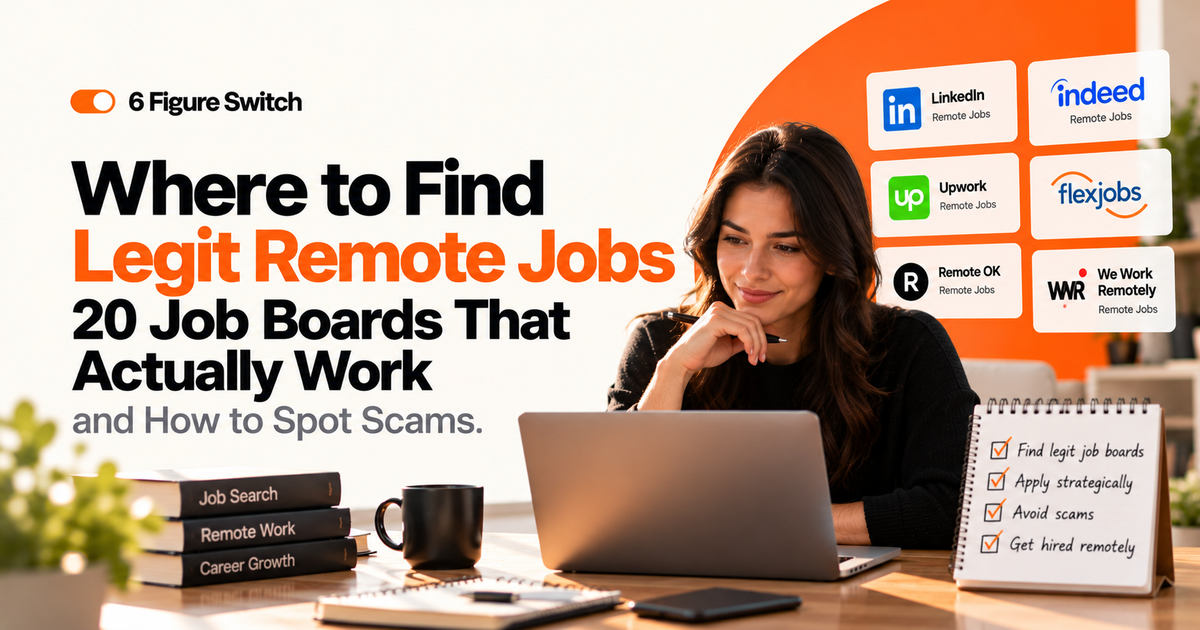
  • Where to Find Legit Remote Jobs: 20 Job Boards That Actually Work (and How to Spot Scams)

    Where to Find Legit Remote Jobs: 20 Job Boards That Actually Work (and How to Spot Scams)

    Home / Journal / Remote Jobs & Work From Home

    Remote Jobs & Work From Home

    Where to Find Legit Remote Jobs: 20 Job Boards That Actually Work (and How to Spot Scams)

    Twenty job boards and platforms where real remote jobs are posted, how to use each one, how to reach jobs that never get posted, and the red flags of a remote job scam.

    • 10 min read
    • By 6FigureSwitch.com
    • 20 job boards · scam checklist

    Type “remote jobs” into a search engine and you’ll get millions of results, endless listings that turn out to be hybrid, and a few offers that are too good to be true because they are. Finding real, well-paid remote work isn’t about searching harder. It’s about searching in the right places, in the right way.

    This guide lists 20 job boards and platforms that remote job seekers actually use, grouped by what they’re best for, with a tip for getting more out of each. Then you’ll learn how to reach the jobs that never get posted, how to recognize a scam in seconds, and a simple weekly system that keeps your search moving without taking over your life.

    01Why your remote job search feels broken

    Most people make the same three mistakes:

    • They search too broadly. “Remote” alone returns jobs you can’t apply to: hybrid roles, jobs limited to one country, or roles far outside your experience.
    • They rely on one site. Different companies post in different places. Startups, nonprofits and tech companies each have favorite boards.
    • They apply and wait. Remote roles attract many applicants. Without a referral or a follow-up, even strong candidates get lost.

    The fix is to combine a few big sites (filtered properly), a few remote-only boards, one or two niche boards for your field, and direct outreach. Let’s go through each.

    02The big job sites, used the right way

    These sites have the most listings. The trick is filtering hard so you only see real remote roles you qualify for.

    Best for: almost every field

    01LinkedIn Jobs

    Use the “Remote” filter, then set the location to the country or region you can legally work in. Turn on job alerts for your exact target title, and check the “People you can reach out to” section on each job to find a contact.

    Pro tip: roles posted in the last 24 to 72 hours get far fewer applicants. Sort by most recent.

    Best for: volume and non-tech roles

    02Indeed

    Search your title plus “remote” and use the remote filter. Indeed is especially strong for customer support, operations, healthcare administration and sales roles.

    Best for: researching companies

    03Glassdoor

    Use it to read reviews and salary reports before you apply, and to filter out companies with poor remote culture. Its job listings overlap with other sites, so treat it mainly as research.

    Best for: tech and startup roles in the US

    04Built In

    Strong for tech companies and their non-engineering roles: marketing, sales, operations, product. Filter by “Remote” and by company size.

    03Remote-only job boards

    These boards list only remote positions, so you skip the noise. Always check the location line: many remote jobs are still limited to certain countries or time zones.

    Best for: tech, design, marketing, support

    05We Work Remotely

    One of the longest-running remote job boards. Listings are paid by employers, which tends to filter out low-quality posts. Check it every few days.

    Best for: tech and startup roles

    06Remote OK

    Large remote board with salary ranges on many listings and filters by tag. Useful for spotting which skills are in demand right now.

    Best for: tech companies, all functions

    07Remotive

    A curated list of remote roles at tech companies, including non-technical jobs in marketing, sales, HR and customer success.

    Best for: browsing by category

    08Working Nomads

    Aggregates remote jobs by category and sends curated email alerts. Good for discovering companies you hadn’t heard of.

    Best for: company research + jobs

    09Himalayas

    Remote jobs with detailed company profiles, time-zone requirements and benefits. Helpful for checking where a company actually hires from.

    Best for: hand-screened listings (paid)

    10FlexJobs

    A subscription service that screens listings for legitimacy and includes part-time and flexible roles. Worth considering if you’re short on time and want fewer scams; free boards are fine otherwise.

    Best for: roles at online businesses

    11Dynamite Jobs

    Remote jobs at bootstrapped and online companies, often with salary ranges shown. Good for operations, marketing and assistant roles.

    Best for: established remote companies

    12Remote.co

    Lists remote jobs and profiles of remote-first companies, with Q&As about how they work. Useful for building a target list of companies.

    04Niche job boards by field

    Niche boards have fewer listings, but much less competition and better matches. Pick the ones for your target field.

    Best for: startups

    13Wellfound

    Formerly AngelList Talent. Startups post roles with salary and equity ranges, and you can apply directly to founders and hiring managers.

    Best for: nonprofits and impact work

    14Idealist

    Thousands of nonprofit and social-impact roles, many remote. Strong for program management, fundraising and communications.

    Best for: designers

    15Dribbble & Behance

    Design communities with job boards. Your portfolio on the same platform makes you easy to evaluate.

    Best for: writers and content roles

    16ProBlogger Jobs

    A long-running board for blogging, copywriting and content jobs, many of them remote or freelance.

    05Freelance platforms (a bridge into a new field)

    Freelancing is one of the fastest ways to get real experience in a new field while keeping your job. Start small, deliver well, and collect testimonials and portfolio pieces.

    Best for: broad freelance work

    17Upwork

    The largest general platform. Start with small, well-defined projects, write tailored proposals, and focus on 5-star reviews over price at the beginning.

    Best for: independent professionals

    18Contra

    Commission-free platform built around a portfolio-style profile. Good for designers, writers, marketers and developers.

    Best for: experienced specialists

    19Toptal

    A selective network for senior developers, designers, finance experts and project managers. Expect a demanding screening process.

    Best for: first clients

    20Your own network

    Former employers, colleagues and local businesses are often the easiest first clients. One message saying “I’m now offering X, do you know anyone who needs it?” can land your first project.

    06The hidden job market: jobs that never get posted

    Many roles are filled through referrals or direct outreach before they reach a job board. You can tap into that market with three habits:

    1. Build a target list of 20 to 30 remote companies in your field. Use the company profiles on Himalayas, Remote.co and LinkedIn to find them.
    2. Follow and engage. Follow the company and two or three people on the team you’d join. Comment thoughtfully on their posts for a few weeks.
    3. Reach out with value. Send a short message: who you are, why their company, one idea or observation, and a simple ask. “Would you be open to a 15-minute chat about how your team works?” goes further than “Are you hiring?”

    When a role opens, you’re no longer a stranger in a pile of applications. You’re the person who already showed interest and initiative.

    07How to spot a remote job scam

    Remote job scams are common, and they target people who are eager to work from home. Walk away immediately if you see any of these:

    • They ask you to pay for training, equipment, software or a “starter kit” before you start. Real employers don’t charge you to work.
    • They send you a check to buy equipment and ask you to send part of the money back or to a vendor. This is a classic fake-check scam.
    • The interview happens only by chat (Telegram, WhatsApp, text) with no video call and no real person you can verify.
    • The offer comes instantly, without a real interview, often for a vague role like “data entry” or “remote assistant” at an unusually high hourly rate.
    • They ask for sensitive information early, such as your bank details or ID number, before a written offer from a verifiable company.
    • The email domain doesn’t match the company website, or the recruiter uses a free email address for a large company.

    To verify a job, find it on the company’s own careers page, look up the recruiter on LinkedIn, and search the company name plus “scam”. If something feels off, trust that feeling. In the US you can report job scams to the Federal Trade Commission; in other countries, contact your national consumer protection authority.

    Rule If you have to pay to get the job, it isn’t a job.

    Make your application "remote-ready"

    Remote employers worry about one thing more than office employers do: will this person work well without someone looking over their shoulder? Answer that question before they ask it.

    • Show written communication. Remote teams run on writing. A clear, short, well-structured application message is already proof. Keep it to five or six sentences.
    • Mention remote experience, even partial. Working with colleagues in other offices, leading video meetings, managing projects in shared tools or working from home during busy periods all count.
    • Name the tools. Slack, Zoom, Google Workspace, Notion, Asana, Jira, Trello: list the ones you use. They’re easy signals that you’ll fit in quickly.
    • Give examples of self-management. “Delivered a 3-month project with weekly async updates to stakeholders in two time zones” says more than “self-motivated”.
    • Be clear about your time zone and availability. State your location and the hours you can overlap with the team. It removes a common reason to reject you.

    A good remote application message has a simple structure: one line on why this company, two lines on the most relevant result you’ve delivered, one line on how you work remotely, and a closing line inviting a conversation. Hiring managers read dozens of these. The short, specific ones get replies.

    Template “Hi [Name], I’m applying for [Role] because [specific reason about the company]. In my current role I [result with a number]. I’ve worked with distributed teams using [tools] and I’m available [hours / time zone]. I’d love to talk about how I could help [team goal].”

    08A weekly remote job search system (5 hours)

    DayTaskTime
    MondayCheck alerts on 2 big sites + 2 remote boards, save 10 matching roles45 min
    TuesdayTailor and send 3 applications (CV top section + short note)1 h
    WednesdayHidden market: 3 thoughtful comments + 2 outreach messages45 min
    ThursdayTailor and send 3 more applications1 h
    FridayFollow up on applications from last week, update your tracker30 min
    WeekendImprove one asset: portfolio piece, LinkedIn section or interview story1 h

    Track everything in a simple spreadsheet: company, role, link, date applied, contact, follow-up date and status. After a month, look at what’s working. If you get interviews from one board or from referrals, double down there and drop the rest.

    09Frequently asked questions

    Are paid job boards worth it?

    Sometimes. A paid service like FlexJobs screens listings, which saves time and reduces scams. But most legitimate remote jobs are also available on free boards. Start free and pay only if you need the filtering.

    How many remote jobs should I apply to each week?

    Quality beats quantity. Six to fifteen well-matched, tailored applications a week, plus outreach, usually works better than mass applying.

    Why do remote jobs say "US only" or list a time zone?

    Companies often limit remote roles because of employment law, taxes, payroll or the need to overlap working hours. Read the location requirements before applying to save time.

    Is freelancing a good way into a remote career?

    Yes, especially for career changers. Small freelance projects give you real experience, portfolio pieces and references in your new field, and some clients turn into full-time offers.

    The bottom line

    Legit remote jobs are out there, but they’re spread across many places. Filter the big sites properly, check a few remote-only boards, add the niche boards for your field, and spend part of every week on the hidden market. Stay alert for scams, track your search, and focus on the channels that bring you interviews.

    If you want a step-by-step plan that turns your search into offers, The 6-Figure Career Switch walks you through it.

    Share this articlePinterestLinkedInFacebookX

    Keep reading

    More from the Journal.

    One remote-career playbook. Every week.

    Free, practical, no spam. Unsubscribe anytime.

  • 10 Daily Habits to Build a New Career While Working Full-Time

    10 Daily Habits to Build a New Career While Working Full-Time

    Home / Journal / Self-Improvement & Mindset

    Self-Improvement & Mindset

    10 Daily Habits to Build a New Career While Working Full-Time

    A realistic one-hour routine and ten habits that help you learn new skills, build your network and change careers without burning out.

    • 10 min read
    • By 6FigureSwitch.com
    • 1-hour routine · 10 habits

    Building a new career while working full-time is mostly a time problem disguised as a motivation problem. You finish work at six, cook, handle family and errands, and by nine o’clock the last thing you want to do is study SQL or rewrite your CV. So you promise yourself you’ll start properly at the weekend, or next month, or after the holidays.

    The people who make the switch don’t have more willpower than you. They have better systems: small daily habits that make progress automatic, even on tired days. This guide gives you a realistic one-hour routine, the ten habits that matter most for career changers, a sample week, and the mindset traps to watch for.

    01Why motivation isn't enough (and what works instead)

    Motivation is a feeling, and feelings change with sleep, stress and the weather. If your career change depends on feeling motivated, it will stop the first busy week at work.

    Habits work differently. Once something is attached to a fixed time and place, it takes far less effort to start. You don’t decide every evening whether to study; you just do the next small step because it’s 7:30 and that’s what happens at 7:30.

    Three principles make habits stick:

    • Make it small. Twenty focused minutes beat a heroic three-hour session you never repeat.
    • Make it specific. “Work on my career” is vague. “Finish lesson 4 of the SQL course” is clear.
    • Make it visible. Track it somewhere you see daily. Progress you can see is progress you keep.

    You don’t rise to the level of your goals. You fall to the level of your systems.

    02The 1-hour daily routine for career changers

    This is the core routine. Do it before work or in the evening, whichever you can protect. If an hour is too much at first, start with 30 minutes and keep the same order.

    10 minutes

    Plan

    Look at your weekly goal and choose today’s single most important task. Write it down. Ten minutes of planning saves an hour of wandering between tabs.

    35 minutes

    Deep work

    Phone in another room, one tab open, one task. This is where you learn the skill, build your project or rewrite your CV. Use a timer and stop when it rings.

    10 minutes

    Connect

    Send one message: a comment on a post in your target field, a thank-you to someone who helped, a request for a short conversation. Careers are built through people.

    5 minutes

    Log

    Write three lines in your switch journal: what you did, what you learned, what’s next. Tomorrow’s you will start faster.

    03The 10 habits that move your career forward

    01Start the day with your own goal

    Before email and social media take your attention, spend a few minutes on your career goal, even if it’s only planning the evening session.

    How to start: put your switch journal next to your coffee machine or on your desk.Make it stick: keep the first action tiny: open the journal and write today’s task.

    02Learn in focused blocks

    Short, distraction-free blocks of 25 to 45 minutes are more effective than long sessions with your phone nearby.

    How to start: use a timer and close everything except the one thing you’re working on.Make it stick: schedule your blocks in your calendar as real appointments.

    03Practice, don't just consume

    Watching tutorials feels productive, but skills grow when you apply them. For every hour of watching, spend at least an hour doing.

    How to start: after each lesson, redo the exercise on your own example.Make it stick: keep a list of mini-projects you can work on when you’re stuck.

    04Build in public

    Share what you’re learning: a short LinkedIn post, a project update, a lesson you found useful. It builds credibility and attracts people in your new field.

    How to start: post once a week about one thing you learned.Make it stick: write the post during your Friday log session so it’s never a separate task.

    05Talk to one new person a week

    Most career changes happen through relationships. One short conversation a week adds up to around fifty new connections in a year.

    How to start: ask people in your target role for 20 minutes with specific questions.Make it stick: end every conversation by asking who else you should talk to.

    06Read job posts like a curriculum

    Job posts tell you exactly what employers want. Reading a few each week keeps your learning focused on what the market actually asks for.

    How to start: save five job posts a week and highlight repeated skills.Make it stick: update your learning list monthly based on what you find.

    07Move your body every day

    Regular movement supports energy, focus and stress management, which you need when you’re doing two things at once.

    How to start: a 20-minute walk, ideally right after work to switch modes.Make it stick: listen to a podcast from your target field while you walk.

    08Protect your sleep

    Studying until midnight on six hours of sleep slows everything down. Consistent sleep makes your daily hour count.

    How to start: set a fixed time when screens go off, and stick to it on most nights.Make it stick: if you can only do the routine late, make it shorter rather than going to bed later.

    09Review your week every Sunday

    A 20-minute review keeps you on track: what worked, what didn’t, what’s the goal next week.

    How to start: answer three questions in your journal: wins, blockers, next week’s one goal.Make it stick: pair it with something you enjoy, like a favorite coffee or a walk.

    10Celebrate small wins

    Career changes take months. Marking progress keeps you going: a finished course, a first project, a reply from a recruiter.

    How to start: keep a “wins” list in your journal and add to it weekly.Make it stick: share a win with a friend or partner who supports your switch.

    04A sample week (5 to 7 hours total)

    DayFocusTime
    MondayPlan the week + learn (course lesson)1 h
    TuesdayPractice (apply the lesson to your project)1 h
    WednesdayConnect (2 messages) + read 5 job posts45 min
    ThursdayPractice (project)1 h
    FridayLight day: log, share one learning post30 min
    SaturdayDeep session: finish a project milestone2 h
    SundayWeekly review + rest20 min

    Adjust the days to your life. Parents of young children often find early mornings or lunch breaks work better than evenings. What matters is that the same blocks happen every week.

    05Protect your energy (so you don't burn out)

    Doing a full-time job and a career change at the same time is demanding. Burning out halfway costs more time than going a little slower. A few rules help:

    • Plan one rest day. At least one day a week with no career work at all.
    • Lower the bar on hard days. If you’re exhausted, do ten minutes and log it. Keeping the chain alive matters more than the amount.
    • Say no to one thing. Most people can find an hour a day by cutting one evening show or some scrolling time. Decide what you’re trading.
    • Ask for support. Tell your partner, family or a friend what you’re doing and why. Shared goals are easier to protect.
    • Notice warning signs. If you’re constantly exhausted, irritable or not sleeping, slow down and talk to someone you trust or a professional.

    06Mindset traps that stall career changers

    Imposter syndrome

    Feeling like a fraud in a new field is normal, especially for capable people. Answer it with evidence: your journal of what you’ve learned and built is proof that you’re making real progress.

    Comparison

    Someone online switched careers in six weeks. Maybe they did, maybe they didn’t. Compare yourself only to where you were last month.

    Perfectionism

    Waiting until your CV, portfolio or skills are perfect means never applying. Aim for good enough to start conversations, then improve with feedback.

    All-or-nothing thinking

    Missing a day doesn’t ruin the plan. Missing a week doesn’t either. Just restart with the next small step. Consistency over months is what wins.

    07Track your progress with three simple numbers

    You can’t see a career change happening day to day, so track it. Each week, write down three numbers:

    1. Hours invested. Are you protecting your time?
    2. Outputs finished. Lessons completed, project milestones, CV versions, posts.
    3. Conversations. New people you spoke with or messaged.

    After four weeks, these numbers show you exactly what’s working. After twelve, they tell the story of how you changed careers, which is a great story to tell in interviews.

    Your first 7 days

    If this feels like a lot, don’t try to adopt all ten habits at once. Start with this first week and add one habit at a time:

    1. Day 1: Choose your daily time slot and block it in your calendar for the next four weeks.
    2. Day 2: Create your switch journal and write your career goal in one sentence.
    3. Day 3: Do your first 35-minute deep work block on the most important skill.
    4. Day 4: Save five job posts and highlight the skills that repeat.
    5. Day 5: Send one message to someone working in your target field.
    6. Day 6: Do a longer session and finish one small piece of work.
    7. Day 7: Do your first weekly review: wins, blockers and next week’s one goal.

    By the end of the week you’ll have a routine, a journal, a direction and your first conversation started. That’s more momentum than most people build in a month of thinking about it.

    Habit stacking: attach new habits to old ones

    The easiest way to build a new habit is to attach it to something you already do every day. The existing routine becomes the trigger. A few examples that work well for career changers:

    • After I pour my morning coffee, I open my switch journal and write today’s one task.
    • After I sit on the train or bus, I read one article or listen to one podcast episode from my target field.
    • After lunch, I save one job post and highlight the skills it asks for.
    • After dinner, I do my 35-minute deep work block before turning on the TV.
    • After I brush my teeth at night, I write three lines in my log.

    Write your own stacks using the formula “After I [current habit], I will [new habit]” and keep each new habit small enough to do on your worst day.

    Simple tools that help (most are free)

    You don’t need a complicated productivity system. A few simple tools are enough:

    • A calendar to block your daily hour like a meeting you can’t miss.
    • A notes app or notebook for your switch journal and weekly reviews.
    • A timer (your phone in another room, or a simple kitchen timer) for focused blocks.
    • A spreadsheet to track hours, outputs, conversations and applications.
    • A website blocker during deep work if social media keeps pulling you away.

    The best tool is the one you’ll actually open every day. Start with what you already use and only add something new if it solves a real problem.

    08Frequently asked questions

    How many hours a week do I need to change careers?

    Five to seven focused hours a week is enough for most career changes over three to nine months. More hours can speed things up, but only if you can sustain them.

    Is it better to study in the morning or evening?

    Whenever you can protect consistently. Many people find mornings better because their energy is higher and fewer things interrupt them, but a reliable evening slot works too.

    What if I miss several days?

    Restart with the smallest possible step, like ten minutes and one log entry. Don't try to catch up all at once. Momentum comes back faster than you expect.

    How do I stay motivated for months?

    Rely on routine rather than motivation, track your progress weekly, celebrate small wins and keep talking to people in your target field. Seeing real people doing the job makes the goal concrete.

    The bottom line

    You don’t need more motivation or more free time to build a new career. You need one protected hour, a few habits that run on autopilot and a way to see your progress. Start small this week: block the time, pick today’s one task and log what you did. Small habits, repeated for a few months, are how big switches happen.

    To make sure that daily hour is pointed at the right target, The 6-Figure Career Switch gives you the full step-by-step plan.

    Share this articlePinterestLinkedInFacebookX

    Keep reading

    More from the Journal.

    One remote-career playbook. Every week.

    Free, practical, no spam. Unsubscribe anytime.
  • Career Change Resume, LinkedIn & Interview Guide (With Before-and-After Examples)

    Career Change Resume, LinkedIn & Interview Guide (With Before-and-After Examples)

    Home / Journal / Resume, LinkedIn & Interviews

    Resume, LinkedIn & Interviews

    Career Change Resume, LinkedIn & Interview Guide (With Before-and-After Examples)

    How to rewrite your CV, LinkedIn and interview answers so recruiters see a strong hire instead of a career changer, with examples you can adapt today.

    • 10 min read
    • By 6FigureSwitch.com
    • Templates · Examples

    When you change careers, your CV has a hard job. It has to convince a recruiter, who spends a few seconds on each application, that someone with a different job title can do this one well. Most career changers send the same CV they’ve always used and hope the recruiter connects the dots. They rarely do.

    This guide shows you how to connect the dots for them. You’ll learn how to translate your experience into the language of your new field, the CV structure that works best for career changers, a LinkedIn checklist, a simple framework for the “why are you changing careers?” question, and how to handle salary. Every section includes before-and-after examples you can adapt.

    01Why most career change CVs get rejected

    It’s rarely because the person isn’t capable. It’s usually one of these:

    • The wrong title on top. The CV opens with “Secondary School Teacher” when the target is “Instructional Designer”. The reader decides in seconds that it’s not a match.
    • Duties instead of results. “Responsible for scheduling” says what you were supposed to do. “Cut overtime 18% by redesigning schedules” says what you achieved.
    • Old-field vocabulary. Every industry has its own words. If yours don’t match the job post, applicant tracking systems and recruiters miss you.
    • No proof of the new skills. A course listed at the bottom isn’t enough. Recruiters want to see you’ve used the skill on something real.

    The fix for all four is the same: write your CV for the job you want, not the job you have.

    02Translate your experience into the new field's language

    Take each of your main achievements and rewrite it in the words your target role uses. Here’s how it looks in practice:

    Before (old field)After (new field)
    Taught 5 classes of 30 studentsDesigned and delivered learning programs for 150 learners a year (instructional design)
    Managed the store's weekly rotaPlanned resources for a 14-person team across 7-day operations (project management)
    Handled customer complaintsResolved 40+ customer escalations a week with a 92% satisfaction score (customer success)
    Kept the clinic's patient recordsMaintained data accuracy for 3,000+ records and audited quality monthly (data / operations)
    Organized the annual company eventDelivered a 300-person event on time and 10% under budget, coordinating 6 vendors (project management)

    Formula Action verb + what you did + scale + result. If you don’t have an exact number, use a careful estimate you can explain in an interview.

    To find the right vocabulary, collect ten job posts for your target role and highlight the words that keep coming back. Those are the terms to use, as long as they honestly describe what you did.

    03The career change CV: structure that works

    For career changers, a hybrid CV works best: it leads with your skills and relevant results, then shows your work history. Here’s the order:

    Section 1

    Header with your target title

    Your name, then the role you’re targeting, not the one you have: “Jane Doe, Project Manager”. Add your city or “Remote”, email, LinkedIn and portfolio link.

    Section 2

    A 3-line summary

    Line 1: who you are now in the new field’s words. Line 2: your strongest transferable proof. Line 3: what you’re bringing to the new role.

    Example: “Operations professional moving into project management. 8 years delivering cross-team projects on time, including a 6-month system rollout for 200 users. Now certified (CAPM) and focused on remote software teams.”

    Section 3

    Key skills (8 to 10)

    Use the exact terms from job posts, grouped: tools (Jira, Asana, Excel), methods (Agile, risk management) and strengths (stakeholder communication).

    Section 4

    Relevant projects

    One to three projects that prove the new skill: a portfolio piece, a project at your current job, freelance or volunteer work. One line on the problem, one on what you did, one on the result.

    Section 5

    Experience, translated

    Your past jobs with their real titles, but bullet points rewritten in the new field’s language, results first. Keep the most relevant 3 to 5 bullets per job.

    Section 6

    Education & certifications

    Degrees, then the certifications relevant to your new role. Leave out older, unrelated training.

    Keep it to one page if you have under ten years of experience, two pages maximum otherwise. Use a simple layout without columns, tables or graphics, so applicant tracking systems can read it.

    04LinkedIn checklist for career changers

    Recruiters search LinkedIn by job title and keywords. If your profile still describes your old career, you won’t show up. Update these elements in this order:

    1. Headline. Use this formula: Target role | 2–3 key skills | Your edge. Example: “Project Manager | Agile, Stakeholder Management | 8 years leading operations teams”.
    2. About section. Four short paragraphs: where you come from, why you’re moving, what you’ve done to prepare, and what you’re looking for. Write in the first person, like you’d speak.
    3. Featured. Pin your best project, a case study or a post where you explain something from your new field.
    4. Experience. Same translated bullet points as your CV, adapted for each role.
    5. Skills. Add the top skills from job posts and ask former colleagues to endorse the ones they’ve seen you use.
    6. Open to work. Set your target job titles and remote preference. You can make it visible to recruiters only.
    7. Activity. Comment thoughtfully on posts from people in your target field two or three times a week. It’s the easiest way to get noticed.

    05Your career change story: the 60-second answer

    In almost every interview you’ll be asked some version of “Why are you changing careers?” A weak answer focuses on what you’re running away from. A strong answer shows a logical path. Use this three-part structure:

    1. Past: what you did and the strength it gave you.
    2. Bridge: the moment you discovered the new field and what you’ve done since to prepare.
    3. Future: why this role, at this company, is the natural next step.

    “For eight years I ran operations for a retail group, which taught me how to keep many moving parts on schedule. The projects I enjoyed most were the system rollouts, so I studied for the CAPM and led our last rollout end to end, on time for 200 users. Now I want to do that full-time, and your team’s focus on remote delivery is exactly where I can contribute.”

    Practice it out loud until it sounds natural, not memorized. Keep it under a minute, and never criticize your old employer or industry.

    065 tough interview questions (and how to answer)

    Question 1

    "You don't have direct experience. Why should we hire you?"

    Don’t apologize. Point to the overlap: “I haven’t held this exact title, but I’ve done the core of the job.” Then give one specific example with a result, and mention your proof project.

    Question 2

    "Aren't you overqualified / too senior for this role?"

    Show you’ve thought it through: you’re choosing the role for long-term growth, you’re ready to learn the specifics, and your experience means you’ll need less hand-holding on everything else.

    Question 3

    "What if you decide you don't like this field?"

    Explain how you tested it before applying: conversations with people in the role, courses, a real project. “I didn’t make this decision on a whim. Here’s what I did to confirm it.”

    Question 4

    "Tell me about a time you learned something quickly."

    Use the STAR method (Situation, Task, Action, Result) with a recent example, ideally the new skill you just learned. It shows you can ramp up fast.

    Question 5

    "What are your salary expectations?"

    Give a researched range rather than a single number, based on the role in your target market. “Based on my research for this role, I’m looking at a range of X to Y, depending on the full package.”

    07Negotiating the offer as a career changer

    Many career changers accept the first number because they’re grateful to be hired. Polite negotiation is normal, and it rarely costs you the offer. Keep it simple:

    • Thank them and ask for time. “Thank you, I’m excited about this. Could I have until Friday to review the full offer?”
    • Anchor on the role, not your past salary. Your new pay should reflect the job’s market rate, not what you earned in a different field.
    • Ask once, with a reason. “Given my experience leading teams and the market range for this role, would you be able to move the base to X?”
    • Look beyond salary. Remote flexibility, a training budget, a review after six months or a signing bonus can be easier for a company to give.

    A short cover letter template for career changers

    Recruiters skim, so keep it to three paragraphs and around 200 words. Adapt this structure:

    Paragraph 1, why this role: “I’m applying for the Project Manager role because your team delivers software for remote-first companies, and coordinating complex rollouts is the part of my work I enjoy and do best.”Paragraph 2, your proof: “In eight years in retail operations I led projects across six departments. Most recently I managed a point-of-sale system rollout for 200 users across 14 stores, delivered on schedule and under budget. To formalize those skills I completed the CAPM certification and now run every project with a shared plan, risk log and weekly reporting.”Paragraph 3, why you, why now: “I’d bring a practical understanding of how real teams adopt new tools, and the calm you only get from having handled a few crises. I’d welcome the chance to talk about how I could help your team deliver.”

    Notice what it doesn’t do: apologize for the career change, repeat the whole CV or talk about what you dislike in your current job.

    Get referred: the message that opens doors

    A referral from someone inside the company is the strongest signal a career changer can have. Most people are happy to help if you make it easy. Here’s a message you can send to a former colleague or a new contact you’ve spoken with:

    “Hi Sam, I hope you’re well! I’m moving into project management after eight years in operations, and I saw that your company is hiring a Project Manager for the platform team. I think my experience leading system rollouts could be a strong fit. Would you be open to referring me, or telling me who the hiring manager is? I’ve attached my CV and a one-page project case study. Thanks either way!”

    Short, specific, and easy to say yes to. Always thank people afterwards and tell them how it went.

    Get past the applicant tracking system

    Many companies use software to sort applications before a person reads them. You don’t need tricks, just a clean file:

    • Use standard section headings: Summary, Skills, Experience, Projects, Education.
    • Avoid text inside images, tables, text boxes and multiple columns.
    • Repeat the job title from the post exactly once or twice where it’s honest to do so.
    • Save as PDF unless the application asks for Word, and name it “Firstname-Lastname-Role.pdf”.

    08Final checklist before you hit "Apply"

    • Target job title at the top of your CV and in your LinkedIn headline
    • 3-line summary that connects your past to the new role
    • Every bullet point starts with a verb and ends with a result
    • Keywords from the job post appear naturally in your CV
    • At least one project that proves the new skill, with a link
    • Simple, one-column layout saved as PDF with a clear file name
    • A 60-second career change story you’ve practiced out loud
    • A researched salary range for the role and location

    09Frequently asked questions

    Should I use a functional CV that hides my work history?

    No. Purely functional CVs make recruiters suspicious. A hybrid CV gives you the same benefit (skills first) while still showing a clear work history.

    Do I need a cover letter?

    When the application allows one, yes. For career changers it's your best chance to explain the switch in your own words. Keep it to three short paragraphs: why this role, your relevant proof, why this company.

    Should I mention a course I haven't finished?

    Yes, as "in progress" with an expected completion month, especially if it's directly relevant. Be ready to talk about what you've learned so far.

    How do I explain a lower-level role than my current one?

    Frame it as an investment: you're entering a field with stronger long-term growth, and your experience will help you progress faster.

    The bottom line

    Recruiters won’t connect the dots for you, so connect them yourself. Lead with your target title, translate your achievements into the new field’s language, show proof, and tell a short story that makes your move feel logical. Do that, and your past career stops looking like a gap and starts looking like an advantage.

    For the complete system, including templates and the full job-search plan, get The 6-Figure Career Switch.

    Share this articlePinterestLinkedInFacebookX

    Keep reading

    More from the Journal.

    One remote-career playbook. Every week.

    Free, practical, no spam. Unsubscribe anytime.

  • 12 High-Income Skills You Can Learn Online (and How Long Each One Really Takes)

    12 High-Income Skills You Can Learn Online (and How Long Each One Really Takes)

    Home / Journal / High-Income Skills

    High-Income Skills

    12 High-Income Skills You Can Learn Online (and How Long Each One Really Takes)

    Twelve skills companies pay well for, how long each really takes to learn alongside a full-time job, where to start and the project that proves you can do it.

    • 11 min read
    • By 6FigureSwitch.com
    • 12 skills · learning plan

    A high-income skill is one that companies pay well for because it directly makes them money, saves them money or protects them from losing it. The good news: most of these skills can now be learned online, often for free or close to it, while you keep your current job.

    The bad news is that the internet is full of “learn this skill and make $10K a month” promises. This guide is the honest version. For each of the 12 skills below, you’ll see what it is, which roles pay for it, a realistic time to become job-ready if you study 5 to 8 hours a week, where to start, and one project that proves you can do it. At the end you’ll find a 12-week learning plan and the simple idea that multiplies your value: skill stacking.

    01What makes a skill "high-income"?

    A skill pays well when three things are true at the same time:

    • It’s tied to results. Revenue, cost savings, risk reduction or speed. If a manager can draw a line from your work to a number on a dashboard, you can negotiate.
    • It’s in demand and short in supply. Many companies need it, and not enough people can do it well.
    • It’s hard to fake. It takes practice to get good, which protects your value once you’re there.

    Notice what’s not on the list: a degree. For most of these skills, employers care far more about what you can show than where you studied. That’s what makes them perfect for career changers.

    02How to choose the right skill for you

    Don’t pick the skill with the highest salary on a list. Pick the one where three circles overlap:

    1. What you’re already close to. An accountant is a few steps from financial modeling. A teacher is close to instructional design and training. A salesperson is close to account management. Closeness means speed.
    2. What you can practice daily. You’ll need 100+ hours of practice. Choose something you can do on real problems, ideally at your current job.
    3. What the market asks for. Search job boards for the skill plus “remote”. If you find hundreds of open roles, there’s demand.

    The time estimates below assume 5 to 8 focused hours a week, which fits around a full-time job. They’re typical ranges, not promises. Some people move faster, especially if the skill is close to their current work.

    Note “Job-ready” means ready to apply and pass interviews for an entry or mid-level role, not mastery. Mastery comes on the job.

    03The 12 skills at a glance

    SkillTime to job-readyBest for people who…
    SQL & data analysis3–4 monthslike spreadsheets and finding answers
    Python for automation & data4–6 monthsenjoy logic and building tools
    Cloud computing4–6 monthscome from IT or support
    Cybersecurity6–9 monthsare careful, curious and methodical
    UX/UI design4–6 monthsnotice what's confusing in apps
    Copywriting & content strategy2–4 monthswrite clearly and persuasively
    Performance marketing3–5 monthslike testing and numbers
    B2B sales1–3 monthsenjoy people and targets
    Project management2–4 monthsalready coordinate work
    Product management6–9 monthslove solving customer problems
    AI automation & no-code2–3 monthshate repetitive tasks
    Financial modeling3–5 monthsthink in numbers and scenarios

    04Technical skills (build, analyze, protect)

    Time to job-ready · 3–4 months

    01SQL & data analysis

    SQL is the language used to pull answers out of databases. Combined with a spreadsheet or dashboard tool, it lets you answer questions like “which customers are leaving and why?”

    Where it pays: data analyst, business analyst, marketing and operations analyst roles, and as a bonus skill in almost any office job.Start here: a free SQL course, then practice on public datasets; add a dashboard tool such as Power BI, Looker Studio or Tableau.Proof project: a dashboard that answers one real business question, with a one-page summary of what you found.

    Time to job-ready · 4–6 months

    02Python for automation & data

    Python is the most beginner-friendly programming language. It’s used to automate boring tasks, clean data, analyze it and build simple tools.

    Where it pays: data science, analytics engineering, automation and software roles.Start here: an introductory Python course, then the pandas library for working with tables of data.Proof project: a script that saves you or a colleague one hour a week, shared on GitHub with a clear README.

    Time to job-ready · 4–6 months

    03Cloud computing

    Most companies run on AWS, Microsoft Azure or Google Cloud. Cloud skills cover setting up, securing and keeping those systems running.

    Where it pays: cloud engineer, DevOps, solutions architect and network architect roles.Start here: the free tier of one cloud provider and its entry certification (for example AWS Cloud Practitioner, then Solutions Architect Associate).Proof project: deploy a small website or app on the cloud, with a diagram of how it’s built and what it costs per month.

    Time to job-ready · 6–9 months

    04Cybersecurity

    Security professionals protect systems and data from attacks: monitoring alerts, fixing weaknesses and responding to incidents.

    Where it pays: security analyst, SOC analyst, GRC (governance, risk and compliance) and security engineering roles.Start here: networking basics, then the CompTIA Security+ certification, plus hands-on labs on free practice platforms.Proof project: a write-up of a home lab where you set up monitoring and investigate a simulated attack.

    Time to job-ready · 4–6 months

    05UX/UI design

    UX designers make apps and websites easy to use. They research users, sketch flows and design screens in tools like Figma.

    Where it pays: UX designer, product designer, UX researcher and web designer roles.Start here: Figma (free plan) and a beginner UX course that teaches research, wireframes and usability testing.Proof project: a case study redesigning one frustrating screen of a real app: problem, research, solution, result.

    05Skills that bring in money (market, write, sell)

    Time to job-ready · 2–4 months

    06Copywriting & content strategy

    Copywriters write words that sell: landing pages, emails, ads. Content strategists plan what a company publishes to attract and convert customers.

    Where it pays: content marketing, email marketing, brand and product marketing roles, and freelance work.Start here: study proven sales pages and rewrite them in your own words every day; learn basic SEO.Proof project: rewrite a local business’s homepage and email sequence, and show the before and after.

    Time to job-ready · 3–5 months

    07Performance marketing

    Performance marketers run paid ads on Google, Meta, TikTok or Pinterest and optimize them against numbers like cost per lead and return on ad spend.

    Where it pays: paid media specialist, growth marketer and marketing manager roles.Start here: the free certifications from Google Ads and Meta, then a small real budget on a side project.Proof project: run a $100 campaign for a small business or your own project and report the results honestly, including what didn’t work.

    Time to job-ready · 1–3 months

    08B2B sales

    Business-to-business sales means helping companies buy products or services, often software. Pay usually includes a base plus commission, so top performers earn well.

    Where it pays: sales development rep, account executive, account manager and sales manager roles.Start here: learn a discovery framework, practice cold outreach and objection handling, and study the product you’d like to sell.Proof project: a short sales plan for a company you admire: target customers, outreach messages and a first-call script.

    06Skills that lead work (organize, decide, automate)

    Time to job-ready · 2–4 months

    09Project management

    Project managers plan the work, keep people aligned and deliver on time and budget. It’s one of the easiest high-income skills to transfer from almost any job.

    Where it pays: project manager, program manager, scrum master and operations roles in every industry.Start here: learn the basics of planning, risk and agile methods; consider the CAPM certification (entry) or PMP (with experience).Proof project: document one project you’ve already run as a case study: goal, plan, problems, result.

    Time to job-ready · 6–9 months

    10Product management

    Product managers decide what a product team builds and why. They connect customers, business goals and engineers.

    Where it pays: associate product manager, product manager and product owner roles.Start here: learn user research, prioritization and basic metrics; read product teardowns and write your own.Proof project: a product teardown of an app you use: who it’s for, what problem it solves, one improvement and how you’d measure it.

    Time to job-ready · 2–3 months

    11AI automation & no-code

    Using AI assistants and no-code tools (like Zapier, Make or Airtable) to automate workflows that used to take hours. Companies need people who can do this safely and reliably.

    Where it pays: operations, marketing ops, revenue ops and automation specialist roles, and as an edge in almost any job.Start here: pick one automation tool, one AI assistant, and automate three repetitive tasks in your current work.Proof project: a before-and-after of an automated process with the time saved per week.

    Time to job-ready · 3–5 months

    12Financial modeling

    Building spreadsheet models that forecast revenue, costs and cash so leaders can make decisions. It’s the core skill of finance careers.

    Where it pays: financial analyst, FP&A, corporate finance and investment roles.Start here: Excel or Google Sheets at an advanced level, then a three-statement modeling course.Proof project: a forecast model for a public company with your assumptions clearly explained.

    07A 12-week learning plan that fits around a full-time job

    Whatever skill you choose, the same structure works:

    1. Weeks 1–2: Foundations. One beginner course only. Take notes in your own words. Stop collecting resources.
    2. Weeks 3–6: Guided practice. Do the exercises, then repeat them on your own data or topic. This is where real learning happens.
    3. Weeks 7–10: Your proof project. Build the project from the list above. Expect to get stuck; getting unstuck is the skill.
    4. Weeks 11–12: Show it. Publish the project (portfolio, GitHub, LinkedIn post), update your profile and start conversations with people in the field.

    Five to eight hours a week is enough. What matters is that you practice every week and finish one real project. A finished project beats five unfinished courses every time.

    Courses give you knowledge. Projects give you proof. Employers hire proof.

    08Skill stacking: how to multiply your value

    The highest earners rarely have one rare skill. They combine two or three useful ones that few people have together. A few examples:

    • Industry knowledge + data: a nurse who learns SQL becomes valuable in health analytics.
    • Sales + writing: a salesperson who writes great emails becomes a strong account executive or growth marketer.
    • Project management + AI automation: a project manager who automates reporting saves the whole team hours every week.
    • Finance + Python: an analyst who automates models moves faster than everyone around them.

    Start with the skill closest to what you already do, then add one more. Your past career becomes your edge instead of something to hide.

    How to show a new skill on your CV and LinkedIn

    Learning the skill is half the job. The other half is making sure recruiters see it. Three simple moves:

    • Put it in your headline. “Operations manager | SQL & dashboards | Process automation” tells a recruiter in one line what you can do.
    • Describe the project like a job. Add your proof project under Experience or Projects with a result: “Built a sales dashboard that cut weekly reporting from 3 hours to 20 minutes.”
    • Use the words from job posts. Recruiters search for exact terms. If ten job posts say “Power BI”, write “Power BI”, not “data visualization software”.

    Red flags when choosing a course

    The online learning market is full of great teachers and a few people mostly selling dreams. Be careful when you see:

    • Income screenshots instead of a clear curriculum.
    • Promises of a job or a specific salary in a few weeks.
    • No projects, only videos to watch.
    • Pressure to buy now with a countdown timer.
    • No way to check reviews outside the seller’s own website.

    A good course shows you exactly what you’ll learn, makes you build things, and lets the results speak for themselves.

    09Frequently asked questions

    Which high-income skill is easiest to learn?

    For most people, project management, copywriting and B2B sales are the fastest to get started with because they build on communication and organization skills you already use. "Easiest" still means consistent practice for a few months.

    Can I learn these skills for free?

    Yes, most have strong free courses and free tools. Paying makes sense for a certification employers ask for, or for a structured program if you need accountability.

    Do I need a certificate?

    For cybersecurity, cloud and project management, certifications help you get past filters. For design, writing, marketing and sales, a portfolio matters more.

    How do I get experience if no one will hire me without it?

    Create it: do projects at your current job, help a small business or nonprofit, freelance on a small scale, or build public projects. Real work for real people counts as experience.

    The bottom line

    You don’t need a new degree to earn more. You need one high-income skill, learned through practice and shown through a real project. Pick the skill closest to your current strengths, give it 12 focused weeks, and then put it in front of the people who hire for it.

    When you’re ready to turn that skill into a better-paid, flexible role, The 6-Figure Career Switch gives you the step-by-step plan.

    Share this articlePinterestLinkedInFacebookX

    Keep reading

    More from the Journal.

    One remote-career playbook. Every week.

    Free, practical, no spam. Unsubscribe anytime.

  • How to Change Careers at 30, 40 or 50: The 90-Day Plan That Actually Works

    How to Change Careers at 30, 40 or 50: The 90-Day Plan That Actually Works

    Home / Journal / Career Change

    Career Change

    How to Change Careers at 30, 40 or 50: The 90-Day Plan That Actually Works

    A step-by-step plan to change careers in your 30s, 40s or 50s without quitting your job first: clarity, skills, proof and a job search in three 30-day phases.

    • 11 min read
    • By 6FigureSwitch.com
    • 3 phases · 12 weeks

    Changing careers in your 30s, 40s or 50s can feel like starting over. You look at job posts asking for “3–5 years of experience” and wonder who would hire someone who has spent a decade doing something else. So you wait for the right moment, the right course or the right amount of savings, and another year goes by.

    Here’s the truth most career advice skips: you are not starting over. You’re starting from experience. The people who switch successfully don’t wing it, and they don’t quit on a Monday out of frustration. They follow a short, structured plan while their current job still pays the bills. This guide gives you that plan, split into three 30-day phases, plus specific advice for each age, a simple money plan and honest answers to the fears that keep most people stuck.

    01Why mid-career is an advantage, not a handicap

    Recruiters don’t only hire skills. They hire judgment, reliability and the ability to work with people, and those take years to build. A 38-year-old switching into project management already knows how to handle a difficult stakeholder. A 47-year-old moving into sales leadership already knows how real customers think. That’s something a 24-year-old with the perfect certificate can’t fake.

    Mid-career changers also bring three assets that are easy to forget:

    • A network. Former colleagues, clients and managers are now spread across many companies. Most career changes happen through someone who already trusts you.
    • Industry knowledge. A nurse who moves into health-tech, or an accountant who moves into fintech, is worth more than an outsider because they understand the customer.
    • Proof of delivery. You have results you can point to. Your job is to describe them in the language of the new role.

    The goal of this plan is to turn those assets into a new title, not to throw them away.

    You’re not starting from zero. You’re starting from experience, and your job is to translate it.

    02Signs it's time to change careers

    Everyone has bad weeks. A career change is about a pattern, not a mood. If three or more of these have been true for six months or longer, it’s time to make a plan:

    • You feel relief on Friday and dread on Sunday, every week.
    • You’ve hit a pay ceiling and the next level doesn’t excite you.
    • Your industry is shrinking, or your role is being automated or outsourced.
    • You’re more interested in what other teams do than in your own work.
    • You want flexibility (remote work, different hours) that your field can’t offer.
    • You’ve stopped learning, and nobody expects you to.

    Notice what’s not on the list: “I hate my boss.” A bad manager is a reason to change jobs. It’s rarely a reason to change careers.

    03Before day 1: three rules for the next 90 days

    Rule 1

    Don't quit yet

    Your salary is the fuel for this plan. It buys you time to learn, test and choose without panic. People who quit first often take the first offer that comes, even if it’s worse than what they left.

    Rule 2

    Protect 5 hours a week

    That’s one hour on four weekday evenings plus a longer session on the weekend. Put it in your calendar like a meeting. Consistency beats intensity: 5 hours a week for 12 weeks is 60 focused hours.

    Rule 3

    Keep a switch journal

    One document where you log what you learn, who you talk to and what you apply for. It keeps you honest, shows your progress on hard weeks, and becomes material for interviews.

    04Days 1–30: Clarity (choose one direction)

    The biggest mistake career changers make is trying to keep every option open. This first month is about narrowing down to one target role you can describe in a single sentence.

    Week 1

    Audit what you already have

    List your last three jobs and, for each, the five tasks you did most and the three results you’re proudest of. Then circle the tasks you enjoyed and were good at.

    Output: a one-page inventory of transferable skills, for example “managing deadlines”, “explaining complex topics” or “negotiating with suppliers”.

    Week 2

    Shortlist 3 possible roles

    Look for roles that use your circled skills and pay more than your current job. Our list of 25 remote jobs that pay $100K+ is a good starting point.

    Output: three role titles, each with 10 saved job posts.

    Week 3

    Talk to people doing the job

    Find two people per role on LinkedIn and ask for 20 minutes: “What does a normal week look like? What do new hires struggle with? How did you get in?” Most people say yes to a short, specific request.

    Output: six conversations and notes on what the job is really like.

    Week 4

    Choose one target

    Score each role from 1 to 5 on interest, pay, how much of your experience it reuses, and how fast you can get in. Pick the highest total, not the most exciting title.

    Output: one sentence: “I’m moving from X to Y because Z.”

    Tip If you can’t decide between two roles, choose the one that reuses more of your past. Speed matters more than perfection in your first switch.

    05Days 31–60: The bridge (skills and proof)

    Now that you know where you’re going, you build the bridge: the few skills the role requires and the proof that you have them. Not a degree, not ten courses. Just enough to be credible.

    Week 5

    Find the real requirements

    Go through your 10 saved job posts and highlight every skill and tool. Keep only what appears in at least half of them. That’s your learning list. Everything else can wait until you’re hired.

    Output: a short list of 4 to 6 must-have skills.

    Week 6–7

    Learn by doing one project

    Pick one course or certification for the biggest gap, then apply it immediately to a real project: a dashboard with real data, a campaign for a local business, a process redesign at your current job.

    Output: one finished project you can show and explain in five minutes.

    Week 8

    Rebrand your profile

    Rewrite your LinkedIn headline and CV summary for the new role. Lead with the target title and your bridge: “Operations professional moving into project management, 8 years delivering multi-team projects on time.”

    Output: an updated LinkedIn, a new CV and a portfolio page or document with your project.

    06Days 61–90: Launch (apply, network, negotiate)

    This is where most people stall: they keep learning because applying feels scary. Set a date and start, even if you don’t feel ready. Your project and profile are enough to get conversations going.

    Week 9

    Activate your network

    Send a short message to 20 people you know: what you’re targeting, why, and one specific ask (an introduction, feedback on your CV, a referral). Warm introductions get answered far more often than cold applications.

    Week 10–11

    Apply with a system

    Aim for 10 to 15 well-matched applications a week. Tailor the top third of your CV to each one, and follow up after five working days. Track everything in a simple spreadsheet: company, role, date, contact, status.

    Week 12

    Interview, then negotiate

    Prepare a 60-second career change story (past, bridge, future) and three examples of results. When the offer comes, ask for time to review it and negotiate once, politely, with a specific number.

    If you don’t have an offer on day 90, that’s normal. You now have a direction, proof, a profile and a pipeline. Keep the weekly routine going: most career changers who stick with it land within three to six months of starting to apply.

    What the 90 days look like in practice

    Here’s an illustrative example of how the plan plays out. Meet a 41-year-old secondary-school teacher who wants a better-paid, more flexible role.

    Days 1–30. Her audit shows she’s strongest at explaining complex topics, designing lessons and managing 30 people at once. She shortlists three roles: instructional designer, corporate trainer and customer education manager. After six conversations, she learns that instructional designers at software companies work remotely, build online courses, and value teaching experience. She chooses that path: “I’m moving from teaching to instructional design because I want to build learning at scale, and I’ve designed hundreds of lessons.”Days 31–60. Her ten saved job posts all mention the same things: a course-authoring tool, basic video editing and a portfolio. She takes one short course on the authoring tool and turns one of her best lessons into a 15-minute interactive module. She rewrites her LinkedIn headline to “Educator moving into instructional design | Online learning, course design, learner engagement.”Days 61–90. She messages former colleagues who now work in ed-tech, shares her module, and asks for feedback and introductions. Two of them refer her to open roles. She applies to twelve positions over three weeks and lands two interviews, using her module as the centerpiece of her story.

    Not every 90 days ends with an offer. But notice what changed: in three months she went from “I’m just a teacher” to a clear target, a portfolio piece, a new profile and real conversations with hiring managers. That’s the job of the plan.

    Your 90-day checklist

    Copy this list into your switch journal and tick it off as you go:

    • Five protected hours a week in your calendar
    • One-page inventory of transferable skills and results
    • Three shortlisted roles, each with 10 saved job posts
    • Six conversations with people doing those jobs
    • One target role written in a single sentence
    • A short list of 4 to 6 must-have skills
    • One finished project you can show in five minutes
    • Updated LinkedIn headline, About section and CV
    • Twenty messages sent to your network with a specific ask
    • A tracker with 10 to 15 tailored applications a week
    • A 60-second career change story you can tell with confidence

    07Specific advice for your 30s, 40s and 50s

    In your 30s

    Speed and experiments

    You have time to test. Take on a side project, freelance gig or internal move to try your new field before committing. Employers see you as early enough to train and experienced enough to trust. Use that window.

    In your 40s

    Lead with leverage

    Don’t apply as a junior. Aim for roles where your management, industry or client experience is part of the value: team lead, specialist with domain knowledge, customer-facing roles. Your network is your biggest accelerator now.

    In your 50s

    Expertise first, not reinvention

    Choose a move that sits next to your expertise: consulting, training, advisory, operations or project leadership in your industry. Keep your CV to the last 15 years, show current tools and certifications, and highlight energy and adaptability in interviews.

    08Your money plan: make the switch safe

    Money stress makes people accept the wrong offer. A simple plan removes that pressure:

    1. Know your floor. Calculate your minimum monthly expenses. That’s the number your next job must cover, not your current salary.
    2. Build a runway. Aim for three to six months of expenses saved before any period without income.
    3. Budget for learning. Most skills can be learned for under a few hundred dollars. Spend on one focused program, not five.
    4. Accept a short dip if the path is clear. A slightly lower first salary in a field where pay grows fast can beat staying stuck. Compare where each path leads in three years, not three months.

    09The 4 fears that keep people stuck (and the honest answers)

    "I'm too old."

    Age matters less than relevance. Show current skills, recent projects and energy. Plenty of people move into new fields in their 40s and 50s, usually by building on what they already know.

    "I'll have to start at the bottom."

    Only if you hide your past. Position your move as a step sideways into a new field, with your experience as the reason you’ll be good at it.

    "I don't know what I want."

    Few people do before they test. That’s what days 1 to 30 are for. Conversations and small projects reveal more than months of thinking.

    "What if I fail?"

    With this plan you keep your job until the new one is signed. The worst case is that you learned new skills and grew your network. That’s not failure.

    10Frequently asked questions

    How long does a career change take?

    Most structured career changes take between three and nine months from decision to new job. The 90-day plan gets you clear, credible and applying. The search itself depends on your field and market.

    Do I need to go back to school?

    Usually not. Regulated professions (law, medicine, some engineering) require degrees, but most business, tech and creative roles hire on skills, certifications and proof of work.

    Should I tell my current employer?

    Not at first. Build your skills and apply quietly. Internal moves are the exception: if your company has a team you'd like to join, talking to your manager can be the fastest route.

    Is it better to switch industry or role first?

    Change one at a time if you can. Moving to a new role in your current industry, or the same role in a new industry, is easier than changing both at once.

    The bottom line

    Changing careers at 30, 40 or 50 isn’t about courage. It’s about a plan you can follow on a tired Tuesday evening. Choose one direction, build a small bridge of skills and proof, then launch with a system while your current job keeps you safe. Ninety days from now, you could be writing a very different sentence about your career.

    If you want every template, script and tracker from this plan in one place, that’s what The 6-Figure Career Switch gives you.

    Share this articlePinterestLinkedInFacebookX

    Keep reading

    More from the Journal.

    One remote-career playbook. Every week.

    Free, practical, no spam. Unsubscribe anytime.

  • 25 Remote Jobs That Pay $100K+ (and How to Land One Without Starting Over)

    25 Remote Jobs That Pay $100K+ (and How to Land One Without Starting Over)

    Home / Journal / Remote Jobs & Work From Home

    Remote Jobs & Work From Home

    25 Remote Jobs That Pay $100K+ (and How to Land One Without Starting Over)

    The remote roles where six figures is realistic, with official median pay, the backgrounds that switch in fastest, and a first step for each.

    • 13 min read
    • By 6FigureSwitch.com
    • 25 jobs · BLS salary data

    Most people who want to work from home start by searching “remote jobs” and get buried in listings for data entry, surveys and call centers. Those jobs exist, but they rarely pay enough to change your life. The good news is that a different group of remote jobs pays six figures, and many of them are open to career changers who don’t have the “perfect” background.

    In this guide you’ll find 25 remote-friendly jobs where $100K+ is realistic, the official median pay for each one, the backgrounds that switch into them most easily, and a concrete first step you can take this week. At the end, you’ll get a simple five-step plan to land one without quitting your current job first.

    01Why most remote job lists miss the point

    Search engines and job boards are full of lists that mix six-figure careers with $12-an-hour gigs. They count how many remote jobs exist, not which ones can replace a good salary. If your goal is a real career switch, you need two things at the same time: work that can be done from anywhere, and a pay level that’s worth leaving your current job for.

    That’s why this list is short and specific. Every job here has a national median close to or above $100,000 and a track record of remote hiring.

    02How we picked these 25 jobs

    Every salary below is the median annual pay reported by the U.S. Bureau of Labor Statistics (May 2025 data). Median means half of workers in that occupation earn more and half earn less. Remote roles at well-funded companies often pay at or above the median, and senior people earn far more.

    We kept jobs that meet three criteria:

    • Remote-friendly: the core work can be done from a laptop, and companies regularly hire for it remotely.
    • Six figures is realistic: the median is at or near $100K, so you’re not chasing a rare top-1% salary.
    • Open to career changers: there’s a clear path in through skills, certifications or a portfolio, not only a specific degree.

    03All 25 jobs at a glance

    JobBLS median payCategory
    1. Software Developer$134,040Tech & security
    2. Information Security Analyst$129,180Tech & security
    3. Computer Network Architect$134,050Tech & security
    4. Database Administrator / Architect$126,760Tech & security
    5. Computer Systems Analyst$105,850Tech & security
    6. Computer Programmer$100,390Tech & security
    7. UX / Web Designer$99,520Tech & security
    8. Data Scientist$120,230Data & numbers
    9. Actuary$130,000Data & numbers
    10. Statistician$105,720Data & numbers
    11. Financial Analyst$103,570Data & numbers
    12. IT Manager (Computer & Information Systems)$175,140Leadership roles
    13. Financial Manager$166,570Leadership roles
    14. Marketing Manager$165,780Leadership roles
    15. Human Resources Manager$149,280Leadership roles
    16. Compensation & Benefits Manager$149,230Leadership roles
    17. Sales Manager$148,270Leadership roles
    18. Public Relations & Fundraising Manager$136,470Leadership roles
    19. Training & Development Manager$133,000Leadership roles
    20. Medical & Health Services Manager$123,860Business & operations
    21. Personal Financial Advisor$105,070Business & operations
    22. Project Management Specialist$102,320Business & operations
    23. Management Analyst / Consultant$101,860Business & operations
    24. Technical Writer$90,390Business & operations

    Tip Don’t pick by salary alone. The best job on this list is the one that reuses the most of what you already know.

    04Tech & security

    These roles have the most remote openings and the clearest skill paths. You don’t need a computer science degree for most of them, but you do need proof you can do the work.

    BLS median pay · $134,040

    01Software Developer

    You design, build and maintain the apps and systems companies run on. Most teams are distributed, so remote work is the norm rather than a perk.

    Switch in from: Analysts, QA testers, technical support, anyone who already automates parts of their job with spreadsheets or scripts.

    First step: Pick one language (Python or JavaScript), build three small projects that solve real problems, and publish them on GitHub.

    BLS median pay · $129,180

    02Information Security Analyst

    You protect a company’s systems and data: monitoring threats, fixing weaknesses and responding to incidents. Demand keeps growing as more work moves online.

    Switch in from: IT support, network or systems administration, compliance, audit, military or police backgrounds.

    First step: Study for the CompTIA Security+ certification. It’s the most common entry ticket into security roles.

    BLS median pay · $134,050

    03Computer Network Architect

    You design the networks and cloud infrastructure that connect offices, data centers and remote teams. Much of the work happens in cloud consoles, which makes it remote-friendly.

    Switch in from: Network technicians, systems administrators, telecom engineers.

    First step: Get hands-on with one cloud platform (AWS, Azure or Google Cloud) and earn its associate-level networking or architect certification.

    BLS median pay · $126,760

    04Database Administrator / Architect

    You organize, secure and speed up the databases a company depends on. When the data is slow or lost, the business stops, which is why the role pays well.

    Switch in from: Data analysts, BI developers, back-office roles that live in large spreadsheets.

    First step: Learn SQL properly, then practice designing and optimizing a database for a real dataset.

    BLS median pay · $105,850

    05Computer Systems Analyst

    You sit between the business and the tech team, figuring out which systems a department needs and how to make them work together.

    Switch in from: Operations, finance, logistics or healthcare professionals who know a business process inside out.

    First step: Document one process at your current job, propose a better tool or workflow, and turn it into a case study.

    BLS median pay · $100,390

    06Computer Programmer

    You write and test the code that turns a design into working software, often maintaining existing systems in finance, insurance or government.

    Switch in from: Self-taught coders, IT support, engineers from other fields.

    First step: Choose the language your target industry uses most and contribute to one open-source project to show real-world code.

    BLS median pay · $99,520

    07UX / Web Designer

    You design websites and app screens that are easy to use. Senior designers at product companies usually earn well above the median.

    Switch in from: Graphic designers, marketers, customer service and teachers (who already think about how people learn and use things).

    First step: Redesign one clunky app or website you know, explain your choices, and build a three-project portfolio.

    05Data & numbers

    If you like patterns and numbers, these roles turn that into one of the most remote-friendly career paths.

    BLS median pay · $120,230

    08Data Scientist

    You use statistics and code to answer business questions: who will churn, which price works best, where costs can be cut.

    Switch in from: Analysts, researchers, engineers, economists, anyone with a quantitative degree.

    First step: Learn Python with pandas, then publish two projects that start with a business question and end with a recommendation.

    BLS median pay · $130,000

    09Actuary

    You measure financial risk for insurers and pension funds. It’s exam-heavy, but once qualified the work is stable, well paid and often remote.

    Switch in from: Math, finance and economics graduates, accountants who enjoy the numbers more than the bookkeeping.

    First step: Pass the first professional exam (Probability) while still employed. Many employers pay for the rest.

    BLS median pay · $105,720

    10Statistician

    You design studies and analyze data for health, tech, government and research. Clean analysis can be done from anywhere.

    Switch in from: Researchers, lab scientists, social science graduates, survey and market research roles.

    First step: Refresh your statistics and learn R or Python, then analyze a public dataset end to end.

    BLS median pay · $103,570

    11Financial Analyst

    You build models and forecasts that help companies decide where to invest. Corporate finance teams increasingly work hybrid or remote.

    Switch in from: Accountants, bankers, business owners, sales operations.

    First step: Get very good at Excel modeling and build a three-statement model for a public company you admire.

    06Leadership roles

    Managers earn the highest medians on this list. They’re harder to land from scratch, but if you already lead people or projects, your next step could be a remote one.

    BLS median pay · $175,140

    12IT Manager (Computer & Information Systems)

    You run a company’s technology: teams, budgets, vendors and security. Many tech-first companies hire these roles remotely.

    Switch in from: Senior IT staff, project managers in tech, systems administrators with team-lead experience.

    First step: Lead one visible project at work (a migration, a new tool rollout) and measure the result.

    BLS median pay · $166,570

    13Financial Manager

    You oversee reporting, budgets and cash for a company or a division. Finance leadership at online businesses is often fully remote.

    Switch in from: Senior accountants, controllers, financial analysts.

    First step: Take ownership of a reporting process and present it to leadership. That’s the bridge from analyst to manager.

    BLS median pay · $165,780

    14Marketing Manager

    You plan campaigns, manage budgets and lead the team that brings in customers. Digital marketing is one of the most remote-ready functions.

    Switch in from: Sales, content creators, social media managers, small business owners.

    First step: Run one campaign end to end (even for a friend’s business) and report the numbers: cost, leads, sales.

    BLS median pay · $149,280

    15Human Resources Manager

    You lead hiring, people policies and employee experience. Distributed companies need HR leaders who understand remote teams.

    Switch in from: HR specialists, recruiters, office managers, team leads.

    First step: Earn an HR certification like SHRM-CP and specialize in remote hiring or onboarding.

    BLS median pay · $149,230

    16Compensation & Benefits Manager

    You design pay structures and benefits so a company can attract and keep people fairly. It’s analytical, specialized and well paid.

    Switch in from: Payroll, HR specialists, financial analysts.

    First step: Learn salary benchmarking and pay-equity analysis, then build a sample pay structure for a fictional company.

    BLS median pay · $148,270

    17Sales Manager

    You lead a sales team, set targets and coach reps. Remote software and service companies hire sales leaders across time zones.

    Switch in from: Top-performing sales reps, account managers, business owners.

    First step: Document your sales results in numbers (quota, deals, growth) before you apply. Sales hiring is numbers-first.

    BLS median pay · $136,470

    18Public Relations & Fundraising Manager

    You shape how an organization is seen and you raise money for nonprofits. Media relations and donor outreach work well remotely.

    Switch in from: Journalists, communications staff, event planners, nonprofit coordinators.

    First step: Build a portfolio: three press pitches, one crisis statement and one fundraising appeal.

    BLS median pay · $133,000

    19Training & Development Manager

    You build the programs that help employees learn new skills. Online training has made this role easy to do remotely.

    Switch in from: Teachers, coaches, trainers, instructional designers.

    First step: Turn one lesson you’ve taught into an online course module. It shows you can design learning, not only deliver it.

    07Business & operations

    These roles reward people who understand how organizations work. They’re some of the easiest to move into from a traditional job.

    BLS median pay · $123,860

    20Medical & Health Services Manager

    You manage operations, staff and budgets in healthcare organizations. Telehealth and health-tech companies hire many of these roles remotely.

    Switch in from: Nurses, clinic coordinators, medical billing and administrative staff.

    First step: Learn the basics of healthcare operations and data (scheduling, billing, compliance) and highlight your clinical experience.

    BLS median pay · $105,070

    21Personal Financial Advisor

    You help people plan their savings, investments and retirement. Video calls made remote advising normal.

    Switch in from: Bankers, accountants, insurance agents, anyone who already gets asked for money advice.

    First step: Check which licenses apply where you live, and start with the certification path your target firm prefers.

    BLS median pay · $102,320

    22Project Management Specialist

    You keep projects on time and on budget. Every industry needs project managers, and remote teams need them more.

    Switch in from: Coordinators, team leads, engineers, event planners, teachers. If you’ve ever run a project, you qualify more than you think.

    First step: Rewrite your CV around projects you delivered, then study for the CAPM (entry) or PMP (with experience).

    BLS median pay · $101,860

    23Management Analyst / Consultant

    You study how a company works and recommend ways to cut costs or grow. Many consultants work remotely or freelance.

    Switch in from: Experienced professionals in any industry, MBAs, operations and strategy roles.

    First step: Pick the industry you know best and package your expertise as a clear problem you solve.

    BLS median pay · $90,390

    24Technical Writer

    You turn complex products into clear guides and documentation. The median is just under $100K, but it’s one of the easiest remote roles to break into, and pay rises with seniority in software and AI companies.

    Switch in from: Teachers, journalists, support agents, engineers who write well.

    First step: Write documentation for a real open-source tool and use it as your first writing sample.

    08How to land one without starting over

    A list of jobs is only useful if you can actually get one. This is the same approach we teach in The 6-Figure Career Switch, in short:

    1. Pick one lane, not five. Choose the job above that best matches what you already do well. A teacher becomes a training manager or instructional designer faster than a data scientist. Overlap with your past is your shortcut.
    2. Close only the gaps that matter. Read ten job posts for your target role and list the skills that show up in at least half of them. Learn those, ignore the rest. One certification or one strong project usually beats three courses.
    3. Translate your experience. Rewrite your CV and LinkedIn in the language of the new role. “Managed the school timetable” becomes “Coordinated schedules and resources for 40 staff and 600 students.” Same job, new vocabulary.
    4. Build proof. Hiring managers trust evidence over potential. A portfolio, a case study or a small freelance project shows you can do the work, and it gives you something real to talk about in interviews.
    5. Apply with a system, then switch safely. Target 10 to 15 well-matched roles a week, follow up, and track everything. Keep your current income until the new offer is signed. That’s the whole idea of the switch: no leap into the void.

    You don’t need to start over. You need to translate what you already know into the language of a better-paid role.

    09Mistakes that slow career changers down

    • Applying everywhere. Sending 200 generic applications feels productive but rarely works. Fewer, tailored applications get more interviews.
    • Collecting courses instead of proof. Certificates help, but a project you can show and explain is what gets you hired.
    • Hiding your past. Your previous career is an asset. A nurse moving into health operations or a salesperson moving into sales management has an edge, so lead with it.
    • Ignoring time zones. Many “remote” jobs are remote within one country or time zone. Read the location line before you apply.
    • Quitting too early. The switch takes months, not weeks. Protect your income while you build skills and apply.

    10Frequently asked questions

    Can I get a $100K remote job without a degree?

    Yes, especially in software development, cybersecurity, UX design, sales and technical writing, where portfolios and certifications often matter more than degrees. Leadership and finance roles are harder without a degree, but experience can make up for it.

    Which remote job is the fastest to switch into?

    It depends on your background. Project management, technical writing and customer-facing sales roles are often the quickest because they reuse skills you already have. Pick the role that overlaps most with your current job.

    Do remote jobs pay less than office jobs?

    Some companies adjust pay by location, others pay the same everywhere. Check the salary range in the job post, and use the medians in this guide as a reference when you negotiate.

    Can I apply to US remote jobs from another country?

    Some companies hire internationally as contractors or through employer-of-record services, but many US roles are limited to US residents. Filter job boards by "worldwide" or by your region, and read the eligibility section before applying.

    The bottom line

    Six-figure remote work isn’t reserved for a lucky few. It’s a set of specific roles, each with a clear way in. Pick the one closest to what you already do, close the few skill gaps that matter, show proof, and apply with a plan while your current job pays the bills.

    If you want the full step-by-step version, with templates for your CV, LinkedIn and job search, that’s exactly what The 6-Figure Career Switch walks you through.

    Source: U.S. Bureau of Labor Statistics, Occupational Outlook Handbook, median pay (May 2025 data): computer & IT, math, management, business & financial, media & communication. Pay varies by employer, location and experience.

    Share this articlePinterestLinkedInFacebookX

    Keep reading

    More from the Journal.

    One remote-career playbook. Every week.

    Free, practical, no spam. Unsubscribe anytime.